Ashwagandha and liver injury: what the safety warnings mean
Supplement safety
Ashwagandha has been linked to liver injury in Australia and overseas. Official warnings describe a rare but potentially serious concern.
Most reported patients recovered after stopping the product. People with current or previous liver problems should avoid ashwagandha, according to Australian safety advice. [2]
“Ashwagandha supplements can cause liver injury in some people.”
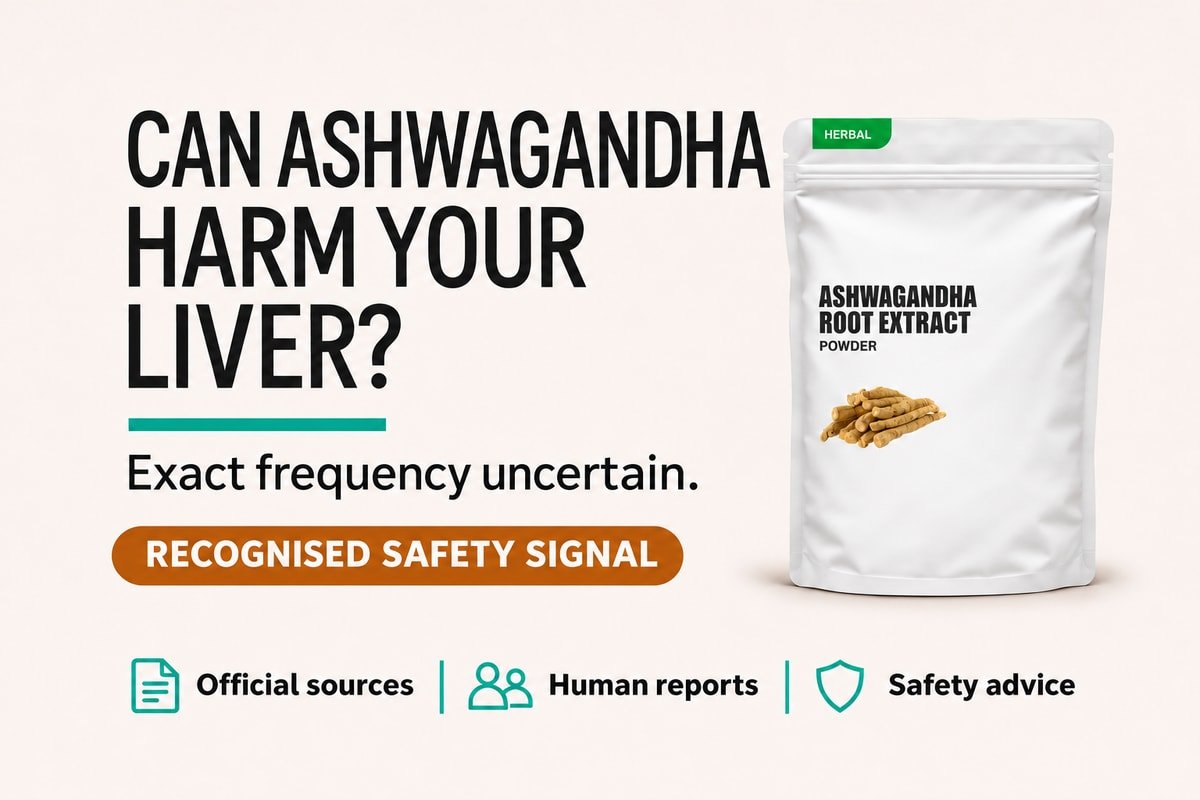
Recognised safety signal
Ashwagandha has a recognised liver-injury safety signal. The risk appears rare, but its exact frequency remains uncertain. Reports and clinical assessments support taking the concern seriously. They do not establish a dependable risk estimate for an individual user. [8]
What kind of liver injury has been reported?
Ashwagandha is also called Withania somnifera. Reports often describe cholestatic injury, meaning disrupted bile flow, or a mixed pattern involving bile-flow problems and liver-cell damage. Symptoms can include jaundice, meaning yellow skin or eyes, and marked itching. [3]
Recovery can take months after the supplement is stopped. The timing and symptoms alone do not establish the cause in an individual person. [3]
What the best evidence says
This article draws on regulator communications and government evidence summaries. Several sources discuss the same underlying cases, so they should not be counted as independent sets of patients.
SupportedAustralia has assessed possible liver-injury reports
The Therapeutic Goods Administration’s 7 July 2026 update described 11 possible liver-injury cases with enough information for assessment. Six involved no other ingredients considered likely contributors. [1]
At publication, the agency had received no reports of associated deaths or liver transplants in Australian consumers. Its update also described severe international cases, including three deaths in patients with acute deterioration on top of chronic liver disease. [1]
These are assessed reports, not a count of every case or proof that ashwagandha caused each event.
SupportedAmerican clinical sources recognise the concern
The United States government’s LiverTox reference assigns ashwagandha likelihood category B, meaning a likely cause of clinically apparent liver injury. This category describes causal evidence, not the percentage of users affected. [3]
The National Institutes of Health Office of Dietary Supplements also discusses liver-injury reports. It notes that some products contained several ingredients and investigators did not independently verify every product’s contents. Long-term safety remains unknown. [4]
UncertainA final British safe-intake conclusion was not established
The United Kingdom Food Standards Agency’s 2024 call for evidence identified potential liver toxicity, thyroid effects and blood-glucose effects. It stated that no safe intake level or set limit had been established for ashwagandha in food supplements. [5]
The Committee on Toxicity discussed a third draft safety statement in September 2026. The relevant paper remained reserved because it contained unpublished information. The records checked for this article did not establish a published final conclusion or safe-dose recommendation. [6]
SupportedSeveral European authorities advise caution or avoidance
The Dutch public-health institute could not establish a safe use level. It advises consumers against using ashwagandha preparations as a precaution and says serious effects may occur even with use according to the packaging. [7] Safety advice
German advice particularly highlights people with liver disease, children, and pregnant or breastfeeding women. Its assessment also found insufficient evidence to derive a safe intake level. [8]
National advice differs. The table below explains the French and Danish positions without treating them as a single European Union rule.
What remains uncertain?
We cannot give a reliable “one in X users” estimate. Reports help identify possible harm, but these official sources do not establish its frequency among all users.
Short trials and inconsistent recording of adverse effects limit the safety evidence. Different plant parts, extracts and concentrations also make products difficult to compare. [8]
Contamination does not explain every reported case: some implicated products were tested without identifying contaminants. However, combination products and incomplete testing still complicate attribution. [4]
European official sources at a glance
On mobile: swipe sideways to view all columns.
| Source | What it found | Main limitations |
|---|---|---|
| Netherlands [7] Safety adviceRisk assessment and public advice, 2024 | Could not establish a safe use level; advises avoidance as a precaution. | Does not identify every susceptible person or quantify an individual’s risk. |
| Germany [8]Risk communication, September 2024 | Highlights liver damage and advises particular groups to avoid use. | Available data do not support a conclusive risk assessment or safe intake level. |
| France [9]Risk assessment, April 2024 | Advises against use in people with liver disorders, pregnant or breastfeeding women, and under-18s, among other groups. | Recommends stronger surveillance for liver, thyroid and cardiac effects. |
| Denmark [10]Current national food guidance | States that selling ashwagandha as food, including supplements, is illegal nationally. | The stated concerns include hormonal, reproductive, immune and nervous-system effects. This is a national restriction. |
Frequently asked questions
Can ashwagandha cause liver injury?
Official sources recognise a liver-injury safety signal. Australian authorities describe the risk as very rare, while the exact frequency remains uncertain. [1]
How soon can symptoms appear?
LiverTox describes onset commonly two to twelve weeks after starting. This timing is a pattern, not a rule that excludes injury outside that window. [3]
Is there a proven safe dose?
The official assessments reviewed here do not establish a dependable intake level that rules out harm. The Dutch assessment notes adverse effects at amounts comparable with those in products sold locally. [7]
Is a root-only extract guaranteed to be safe?
That guarantee is not supported by these sources. Plant part and extraction method change a product’s composition, and the assessments do not establish which preparations account for the reported injuries. [8]
Does a short trial showing good tolerability settle the question?
No. Short trials cannot reliably exclude a very rare reaction. Studies also differ in their preparations, doses and reporting of adverse effects, while safety over many months or years remains uncertain. [4]
References
These sources include official assessments, safety communications and clinical summaries. They are not all independent datasets.
- Therapeutic Goods Administration. Withania somnifera (Ashwagandha) and very rare risk of liver injury. 7 July 2026.Regulator safety update.
- Therapeutic Goods Administration. Medicines containing Withania somnifera (Withania, Ashwagandha). 22 February 2024.Consumer safety advisory.
- National Institutes of Health, LiverTox. Ashwagandha. Updated 3 December 2024.Government clinical evidence summary.
- National Institutes of Health, Office of Dietary Supplements. Ashwagandha: Is it helpful for stress, anxiety, or sleep?. Updated 2 May 2025.Professional fact sheet.
- Food Standards Agency. Ashwagandha: call for evidence. Consultation held 8 July to 2 September 2024.Government consultation document.
- Committee on Toxicity. 8th September 2026 Committee on Toxicity Meeting. September 2026 meeting record.Official record of a draft assessment.
- National Institute for Public Health and the Environment, Netherlands. Risk assessment of herbal preparations containing Withania somnifera (Ashwagandha). 2024, report 2024-0029.National risk assessment.
- German Federal Institute for Risk Assessment. Ashwagandha: food supplements with potential health risks. 10 September 2024.National risk communication.
- French Agency for Food, Environmental and Occupational Health and Safety. Risks associated with preparations of Withania somnifera in food supplements. 19 April 2024.National risk assessment, in French; title translated.
- Danish food authority. Ashwagandha in food supplements and drinks. Current guidance checked 8 November 2026.National guidance, in Danish; title translated.