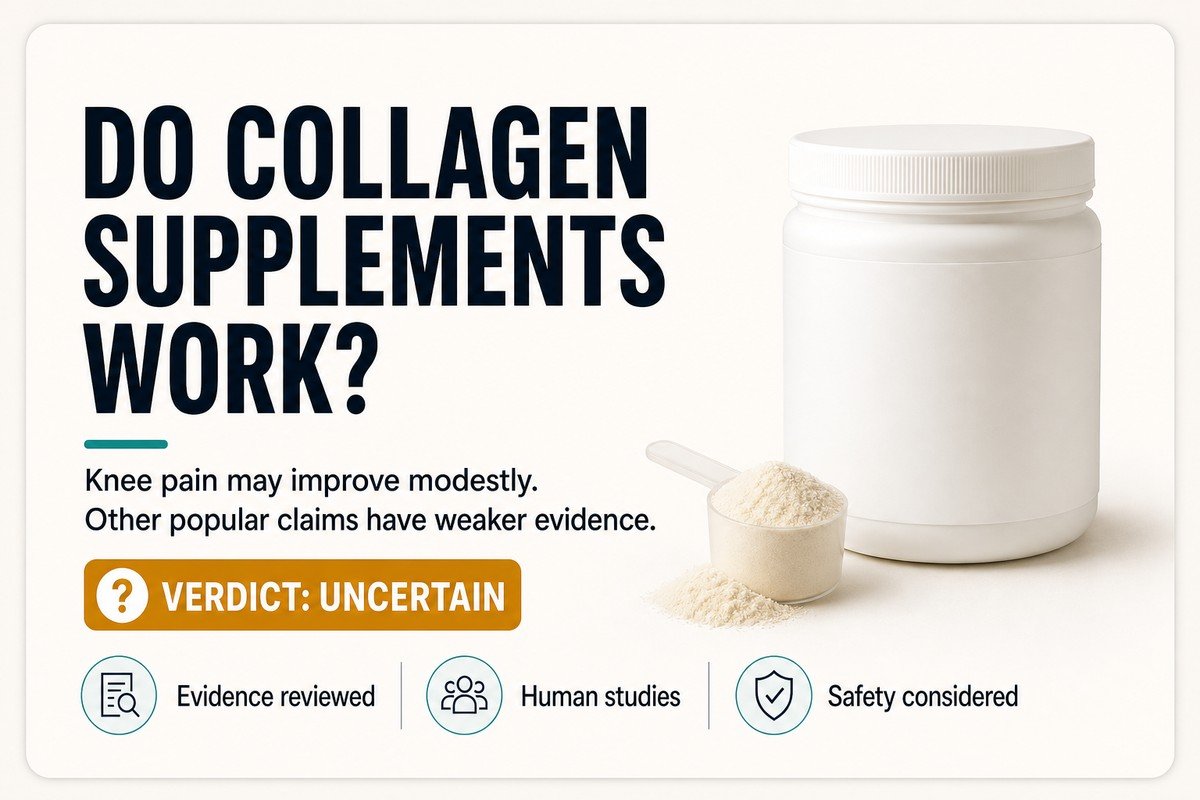
Do collagen supplements work?
Collagen powder is sold as a shortcut to younger skin, thicker hair, calmer digestion, easier weight loss, and pain-free joints. The biology is real, but the clinical benefits depend on the outcome and the exact product.
WEH verdict
Some small collagen-derived peptides appear in blood after hydrolysed collagen is consumed, but that does not mean they rebuild the body on command. The best clinical signal is a possible modest reduction in knee osteoarthritis symptoms. Evidence for skin, hair, cellulite, gut health, and weight loss is weaker, inconsistent, or tied to specific commercial products.
Evidence grade
High risk of bias and product-specific resultsClaim Being Checked
Oral collagen supplements improve skin elasticity and wrinkles, reduce cellulite or loose skin, improve gut health, support weight loss, grow hair, and relieve joint or knee pain.
Plain-English Summary
Human pharmacokinetic studies have repeatedly detected specific hydroxyproline-containing dipeptides and tripeptides in blood after hydrolysed collagen is consumed. This supports the narrow absorption finding, but it does not show that every peptide survives intact, reaches a chosen tissue, or produces a visible benefit [1] [17] [18] [19].
The clinical record is mixed. Recent reviews report positive results for some skin and joint outcomes, yet they also find widespread risk of bias, industry involvement, inconsistent products, and limited independent replication [2] [3] [4].
What The Best Evidence Says
SupportedSome small collagen-derived peptides enter the bloodstream after hydrolysed collagen is consumed
Hydrolysed collagen contains a mixture of small protein fragments. In a 2024 randomized, double-blind crossover study, healthy adults consumed 10 g of fish, porcine, or bovine collagen hydrolysate. Blood testing detected rises in free hydroxyproline and specific hydroxyproline-containing dipeptides and tripeptides, including Pro-Hyp, Hyp-Gly, and Gly-Pro-Hyp [1].
This was not the only human absorption experiment. Earlier small studies also detected post-dose increases in collagen-derived peptides such as Pro-Hyp, Hyp-Gly, and Gly-Pro-Hyp in plasma, with some peptides later recovered in urine [17] [18] [19]. Replication makes the narrow absorption conclusion more credible than the six-person study alone would suggest.
The studies do not show that all peptides in the powder are absorbed intact, that the circulating amounts are clinically important, or that the peptides reach skin, hair, joints, or the gut and cause a health benefit.
UncertainSkin elasticity, wrinkles, cellulite, and loose skin
A 2025 meta-analysis combined 23 randomized trials with 1,474 participants. Pooled results favoured collagen for hydration, elasticity, and wrinkles. However, the apparent benefits disappeared in trials without pharmaceutical-company funding and in higher-quality trials [2].
A 2026 systematic review found positive results in many of 25 randomized trials, but most included trials had a high risk of bias and sample sizes ranged from 13 to 236 [3]. A broader 2026 umbrella review also reported favourable skin and joint outcomes, while warning that many underlying reviews were low or critically low quality [4].
One 2026 placebo-controlled trial in 114 women reported improvements in cellulite, elasticity, and hair-shaft diameter after 24 weeks with a specialized fish-collagen peptide. Company research staff were among the authors, and 99 participants were included in the per-protocol analysis [5]. This result does not establish that ordinary collagen products work the same way. Reliable direct evidence for tightening loose skin was not found.
Not supportedGeneral gut-health and leaky-gut claims
The main positive published study recruited 40 women, but only 14 completed the eight-week collagen phase. It had no placebo group, was open label, and included researchers affiliated with the collagen manufacturer. Thirteen of the 14 completers reported fewer digestive symptoms [6].
A randomized crossover study in 20 athletes found no difference between collagen and placebo in gastrointestinal symptoms or gut-integrity measures during exercise [7]. A larger manufacturer-sponsored trial with 116 participants has finished, but no results were posted when this article was reviewed [8].
UncertainWeight loss and weight gain
A 2022 meta-analysis of 12 randomized trials reported about 1.2 kg less fat mass with collagen, but the trials covered mixed populations and outcomes. The analysis did not establish durable loss of body weight or show that collagen acts like a weight-loss treatment [9].
In a 12-week trial of 74 adults aged 50 or older, a commercial collagen group had a more favourable change in fat mass than placebo. Total body mass did not significantly change, the placebo group gained fat while the collagen group remained broadly stable, and the research received company funding [10].
Exercise studies suggest collagen may alter fat-free mass when combined with training, but that is not evidence that collagen alone causes weight loss [11]. Collagen provides calories like other proteins, but no reliable evidence shows that it uniquely causes weight gain.
UncertainHair growth and hair loss
The 2026 fish-collagen trial reported a greater increase in hair-shaft diameter than placebo [5]. A thicker measured shaft is not the same as creating new follicles, increasing hair count, or treating androgenetic alopecia.
In a company-run trial of collagen plus vitamin C, hair count rose by 27.6% relative to placebo, but the difference was not statistically significant. Subjective healthy-appearance ratings did improve [12]. A major systematic review of nutritional treatments for hair loss did not identify collagen alone among its best-supported interventions [13].
Plausible, not provenKnee osteoarthritis pain and function
A 2025 meta-analysis of 11 randomized trials and 870 participants found improvements in pain and function. Results varied substantially between trials, with statistical heterogeneity of 88% for pain and 75% for function [14].
A separate meta-analysis of four trials and 507 participants also found pain relief, but every included trial was judged to have a high risk of bias [15]. A 2025 independent randomized trial in 68 people found no advantage over placebo for pain, function, rescue medicine use, or satisfaction [16].
Hydrolysed collagen peptides and undenatured type II collagen are different products. Evidence for one formulation should not be assumed to apply to another. No credible evidence shows that oral collagen rebuilds cartilage or reverses osteoarthritis.
Why We Rate It This Way
The overall evidence grade is low. We downgraded the evidence for high or unclear risk of bias, inconsistent results, short follow-up, different collagen formulations, product-specific effects, and frequent manufacturer involvement. Joint-pain evidence is plausible but not conclusive; skin, hair, and weight claims remain uncertain; broad gut-health claims are not supported by reliable published trials.
What This Does Not Prove
Absorbing collagen fragments does not mean your body sends them directly to a wrinkle, hair follicle, painful knee, or intestinal lining.
- It does not prove that all collagen sources, doses, or brands are equivalent.
- It does not prove that collagen tightens loose skin or reverses skin ageing.
- It does not prove that collagen repairs a leaky gut or changes the microbiome in a helpful way.
- It does not prove that collagen is a weight-loss treatment.
- It does not prove that collagen treats a diagnosed hair-loss disorder.
- It does not prove that collagen rebuilds cartilage or reverses osteoarthritis.
Key Studies
On mobile: swipe sideways to view all columns.
| Source | What it found | Main limitations |
|---|---|---|
| 2024 randomized crossover absorption pilot, N = 6 [1] | Free hydroxyproline and specific collagen-derived dipeptides and tripeptides increased in blood after four hydrolysed collagen formulations. | Single 10 g dose; only six healthy adults; manufacturer-funded; no tissue-delivery or clinical outcomes. |
| Earlier human absorption studies [17] [18] [19] | Repeatedly detected Pro-Hyp, Hyp-Gly, Gly-Pro-Hyp, or other hydroxyproline-containing peptides in plasma after collagen hydrolysate or tripeptide ingestion. | Very small samples; different products and doses; several industry affiliations; no proof of target-tissue delivery or benefit. |
| Myung and Park 2025, meta-analysis of 23 RCTs, N = 1,474 [2] | Pooled skin measures improved, but higher-quality and non-industry trials showed no benefit. | Small heterogeneous trials; strong funding and quality effects. |
| Bassila et al. 2026, systematic review of 25 RCTs [3] | Many trials reported better hydration, elasticity, or wrinkles. | Most trials had high risk of bias; samples ranged from 13 to 236. |
| Ravindran et al. 2026, umbrella review of 16 meta-analyses and 113 RCTs [4] | Reported favourable skin and musculoskeletal outcomes overall. | Many underlying reviews were low or critically low quality; overlapping trials. |
| Hwang et al. 2026, randomized placebo-controlled trial, N = 114 [5] | A specialized fish-collagen peptide improved cellulite measures and hair-shaft diameter. | One proprietary product; company researchers; per-protocol efficacy analysis of 99 women. |
| 2022 digestive-symptom study, 40 enrolled and 14 completed [6] | Most completers reported fewer digestive symptoms. | No placebo; open label; 65% attrition; manufacturer affiliations. |
| 2023 exercise-GI crossover RCT, N = 20 [7] | No improvement in GI symptoms or gut-integrity measures versus placebo. | Very small, short, exercise-specific, and supplement supplied by funder. |
| 2022 body-composition meta-analysis of 12 RCTs [9] | Reported about 1.2 kg lower fat mass, but not a proven weight-loss effect. | Mixed populations, products, and outcomes; limited long-term data. |
| Park et al. 2023, double-blind RCT, N = 74 analyzed [10] | Fat-mass change favoured collagen over 12 weeks; total mass did not significantly change. | Commercial formulation; company-funded; placebo group gained fat. |
| Reilly et al. 2024, company-run placebo-controlled trial [12] | Hair count difference was not significant; subjective appearance improved. | Collagen plus vitamin C; all authors worked for the product company. |
| Simental-Mendía et al. 2025, meta-analysis of 11 RCTs, N = 870 [14] | Pain and function measures favoured collagen in knee osteoarthritis. | High heterogeneity; mixed collagen formulations and trial quality. |
| Yuenyongviwat et al. 2025, independent double-blind RCT, N = 68 [16] | No advantage over placebo for knee pain, function, rescue medicines, or satisfaction. | Combined collagen formulation; 12-week duration; modest sample. |
Bottom Line
Collagen is not useless, but it is oversold. It may offer modest symptom relief for some people with knee osteoarthritis. Skin and hair benefits remain uncertain, and general claims about gut healing or weight loss are not supported well enough to guide health decisions.
FAQ
What are collagen peptides, and what happens after you swallow them?
Collagen peptides are small protein fragments made by hydrolysing collagen. Small human pharmacokinetic studies have repeatedly detected specific hydroxyproline-containing dipeptides and tripeptides in blood after ingestion. This supports the narrow absorption finding, but the studies are very small and do not show that all peptides remain intact, reach a chosen tissue, or cause a health benefit [1] [17] [18] [19].
Can collagen improve skin elasticity, wrinkles, cellulite, or loose skin?
Possibly by a small amount for some outcomes, but the evidence is uncertain. Many trials are small or industry-linked, and higher-quality or non-industry analyses are less convincing. One specialized fish-collagen product improved cellulite measures, but reliable evidence for loose-skin tightening was not found [2] [5].
Does collagen improve gut health?
Can collagen help weight loss or cause weight gain?
Does collagen promote hair growth or reduce hair loss?
References
- Absorption of bioactive peptides following collagen hydrolysate intake: a randomized, double-blind crossover study in healthy individuals. 2024.
- Myung SK, Park Y. Effects of collagen supplements on skin aging: a systematic review and meta-analysis of randomized controlled trials. 2025.
- Bassila C, Bassila JC, Slim M. Efficacy and safety of hydrolyzed collagen supplementation on skin health outcomes: a systematic review of randomized trials. 2026.
- Ravindran R, et al. Collagen supplementation for skin and musculoskeletal health: an umbrella review of meta-analyses. 2026.
- Hwang S, et al. Low-molecular-weight collagen peptide supplementation and cellulite, skin elasticity, and hair-shaft diameter. 2026.
- Effect of a daily collagen peptide supplement on digestive symptoms in healthy women: a two-phase mixed-methods study. 2022.
- The effects of collagen peptides on exercise-induced gastrointestinal stress: a randomized controlled trial. 2023.
- ClinicalTrials.gov NCT06937801. Collagen peptides for gastrointestinal discomfort in healthy adults. Results not posted at review.
- Effects of collagen peptide supplementation on cardiovascular markers: a systematic review and meta-analysis of randomized placebo-controlled trials. 2022.
- Park J, et al. Low-molecular collagen peptide supplementation and body fat mass in adults aged 50 years or older. 2023.
- Bischof K, et al. Collagen peptide supplementation with physical training: a systematic review and meta-analysis. 2024.
- Reilly DM, et al. Hydrolysed collagen supplementation and skin, scalp, and hair outcomes: a randomized placebo-controlled trial. 2024.
- Drake L, et al. Evaluation of the safety and effectiveness of nutritional supplements for treating hair loss: a systematic review. 2023.
- Simental-Mendía M, et al. Effect of collagen supplementation on knee osteoarthritis: an updated systematic review and meta-analysis of randomized trials. 2025.
- Analgesic efficacy of collagen peptide in knee osteoarthritis: a meta-analysis of randomized controlled trials. 2023.
- Yuenyongviwat V, et al. Combined undenatured type II and hydrolysed collagen for knee osteoarthritis: a randomized controlled trial. 2025.
- Iwai K, et al. Identification of food-derived collagen peptides in human blood after oral ingestion of gelatin hydrolysates. 2005.
- Yamamoto S, et al. Absorption and urinary excretion of peptides after collagen tripeptide ingestion in humans. 2016.
- Iwasaki Y, et al. Comparison of gelatin and low-molecular-weight gelatin hydrolysate ingestion on hydroxyproline, Pro-Hyp, and Hyp-Gly concentrations in human blood. 2022.
Disclaimer
This article is for general educational information only and is not medical advice. It does not diagnose, treat, or replace care from a qualified health professional. Always speak with a qualified health professional about personal health questions, medicines, pregnancy, medical conditions, or before changing treatment.