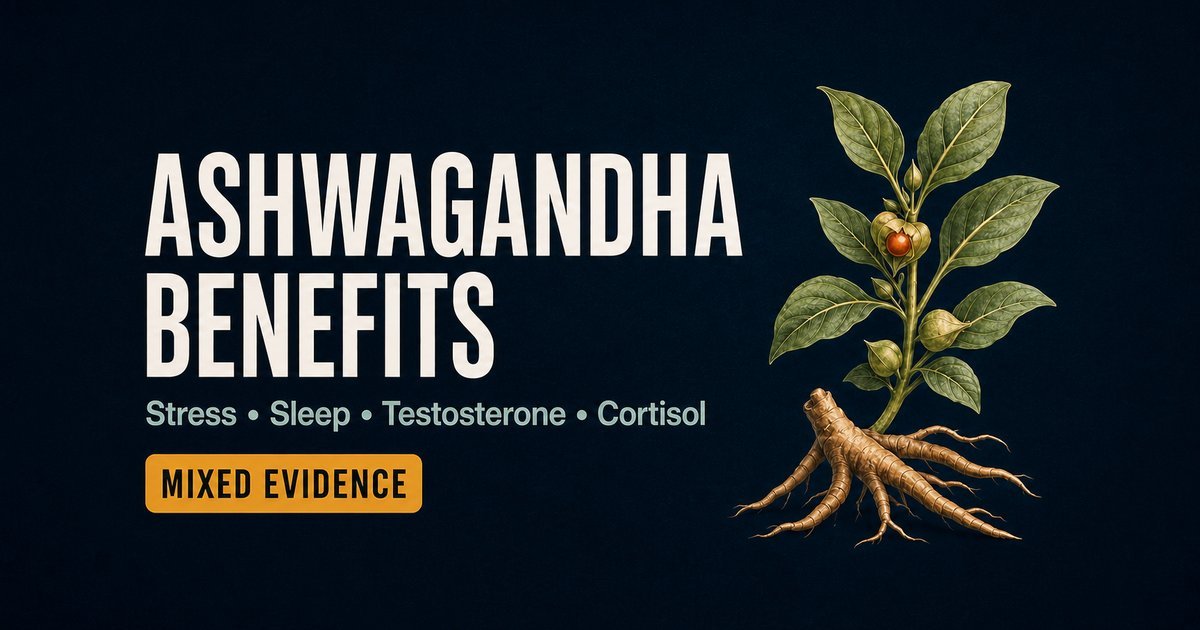
Ashwagandha Benefits
Evidence check
Ashwagandha has several possible short-term effects. None is as certain or as dramatic as many search results imply.
The best-supported signals are modest improvements in some sleep measures and lower measured cortisol. Perceived stress is inconsistent, and a testosterone rise has not been shown to treat clinically low testosterone.
The claim being checked
“Ashwagandha reduces stress, improves sleep, increases testosterone and lowers cortisol.”
This bundles four different outcomes into one promise. Human trials have tested all four, usually for 6 to 12 weeks, but they used different proprietary extracts, doses and populations. A result for one branded extract is not proof that every powder, gummy or capsule works the same way.
Evidence at a glance
Perceived stress
Uncertain. Older pooled studies were positive, but the newest focused meta-analysis and a 120-person trial were null.
Sleep
Plausible, not proven. Some subjective and actigraphy measures improve, but the practical effects are generally small.
Testosterone
Uncertain. A modest rise is possible in some men, but treatment of diagnosed low testosterone is untested.
Cortisol
Plausible biochemical effect. Levels may fall modestly, but the health importance is unknown.
What the best evidence says
Open each card for the result and the main reason for caution.
Uncertain
Does ashwagandha reduce perceived stress?
A 2022 meta-analysis of 12 randomised controlled trials, or RCTs, involving 1,002 participants reported a large reduction in stress. However, results varied substantially between studies and the authors rated certainty low.2
A newer 2025 meta-analysis reached a different conclusion. Its pooled Perceived Stress Scale result was not statistically significant. A separate 120-person placebo-controlled trial also found no advantage for ashwagandha on its primary stress outcome.13
WEH interpretation: Some people may feel better, but the present evidence cannot support a reliable or predictable stress-relief claim.
Plausible, not proven
Does ashwagandha improve sleep?
A 2021 meta-analysis combined five placebo-controlled RCTs with 400 participants. The overall result favoured ashwagandha, but the studies were small and inconsistent, and the Pittsburgh Sleep Quality Index result by itself was not statistically significant.4
In a newer 200-person trial, the ashwagandha-only group had modest advantages over placebo after eight weeks. Calculated from the reported changes, participants fell asleep about 7 minutes sooner, slept about 7 minutes longer and improved by about 1.5 extra points on the sleep-quality questionnaire.5
WEH interpretation: Sleep may improve slightly over several weeks, especially in people already reporting sleep difficulty. This does not establish ashwagandha as a treatment for chronic insomnia.
Uncertain
Does ashwagandha increase testosterone?
A 2026 hormonal meta-analysis found that men taking ashwagandha averaged about 57 ng/dL more total testosterone than placebo. The result in women was not statistically significant.6
The male trials were small and short and included healthy, resistance-training, stressed, overweight or sexually concerned men. No qualifying trial was found in men with diagnosed hypogonadism, meaning symptoms plus repeatedly low morning testosterone. A newer 76-person trial found no statistically significant total or free testosterone increase.7
WEH interpretation: A small laboratory change is possible in some men. That is not evidence that ashwagandha treats low testosterone, improves fertility or reproduces the benefits of prescribed testosterone therapy.
Plausible, not proven
Does ashwagandha lower cortisol?
The 2025 meta-analysis found an average cortisol reduction of 1.16 micrograms per decilitre. A 2026 hormonal meta-analysis also found lower cortisol, but results varied greatly between studies, publication bias was detected and individual studies had a strong influence on the pooled estimate.16
WEH interpretation: Ashwagandha probably lowers a measured cortisol value modestly in some stressed adults. A lower single morning result does not prove better health, better sleep or less day-to-day stress.
What this means in real life
Expect a possible nudge, not a transformation. In the better recent sleep trial, ashwagandha’s advantage over placebo was measured in minutes, not hours. The average testosterone increase was modest and was not shown to improve symptoms. Cortisol may fall on a laboratory test, but people do not consistently report feeling less stressed.
If someone tries ashwagandha and notices nothing, that is entirely compatible with the trial evidence. The studies do not show that everyone responds.
What this does not prove
- It does not prove that all ashwagandha products are equivalent.
- It does not show sustained benefits beyond a few months.
- It does not establish treatment for anxiety disorders, chronic insomnia or diagnosed low testosterone.
- It does not show that lowering cortisol is beneficial by itself.
- It does not establish meaningful benefits specifically for women or a broad package of “benefits for men.”
Safety and side effects
Short-term trials mostly report mild effects such as nausea, stomach upset, diarrhoea, headache or drowsiness. In a large 2026 eight-week trial of 1,002 adults, no serious adverse events were reported and overall adverse-event rates were not higher with ashwagandha than placebo.10
That does not settle long-term safety. A systematic review found that adverse events were assessed in only six of nine cortisol studies and described adequately in just two.8
The NIH notes that long-term safety is unknown, rare liver injury has been reported, and ashwagandha can affect thyroid function or interact with medicines. It should be avoided during pregnancy and while breastfeeding.9
Key studies
An RCT randomly assigns participants to a treatment or comparison group. This reduces some forms of bias, although small or poorly reported RCTs can still give misleading estimates.
On mobile: swipe sideways to view all columns.
| Source | What it found | Main limitations |
|---|---|---|
Albalawi 2025 meta-analysis1 |
Cortisol fell by 1.16 micrograms per decilitre. Perceived stress was not significantly better than control. | Small studies, moderate risk of bias and unclear allocation concealment in some trials. |
Akhgarjand 2022 meta-analysis2 |
Reported a large improvement in stress and anxiety. | Very high heterogeneity and low certainty. Conflicts with newer pooled evidence. |
Cheah 2021 sleep meta-analysis4 |
Overall sleep outcomes favoured ashwagandha. | Few small studies, proprietary extracts, inconsistent outcomes and no long-term data. |
Movva 2026 sleep RCT5 |
Ashwagandha produced modest improvements in sleep latency, efficiency and perceived sleep quality. | Per-protocol efficacy analysis, single site, proprietary extract and reporting concerns. |
Fornalik 2026 hormonal meta-analysis6 |
Men averaged 57.43 ng/dL more total testosterone than placebo. Cortisol also fell. | Varied populations, products and doses. Cortisol heterogeneity was extreme. Clinical benefit was not shown. |
Smith 2023 placebo-controlled RCT3 |
The primary perceived-stress outcome was null. Total testosterone in men was also null; free testosterone was borderline positive. | Manufacturer funded, subgroup hormone analysis and multiple outcomes. |
Frequently asked questions
What are the main benefits of ashwagandha?
Does ashwagandha reduce stress and cortisol?
It may lower measured cortisol modestly in some stressed adults, but perceived-stress results are inconsistent. A lower cortisol value does not by itself prove improved health or wellbeing.1
Does ashwagandha help with sleep?
Does ashwagandha increase testosterone?
Are ashwagandha benefits different for men and women?
The testosterone signal has mainly been reported in men. A recent meta-analysis did not find a statistically reliable testosterone increase in women. The evidence is not strong enough to promise a separate package of benefits for either sex.6
What are the side effects of ashwagandha?
Short trials mostly report mild nausea, stomach upset, diarrhoea, headache or drowsiness. Long-term safety is uncertain, rare liver injury has been reported, and interactions are possible. It should be avoided during pregnancy and while breastfeeding.9
References
- Albalawi A. Systematic review and meta-analysis of ashwagandha effects on perceived stress and cortisol. 2025. PMID: 40746175.
- Akhgarjand C, et al. Does Ashwagandha supplementation have a beneficial effect on the management of anxiety and stress? A systematic review and meta-analysis of randomized controlled trials. 2022. PMID: 36017529.
- Smith SJ, et al. Placebo-controlled trial of an ashwagandha root extract in adults with stress and fatigue. 2023. PMID: 37740662.
- Cheah KL, et al. Effect of Ashwagandha extract on sleep: A systematic review and meta-analysis. 2021. PMID: 34559859.
- Movva S, et al. Randomised placebo-controlled trial of ashwagandha and melatonin for sleep. 2026. PMID: 42029558.
- Fornalik H, et al. Systematic review and meta-analysis of the hormonal effects of ashwagandha. 2026. PMID: 41740946.
- Khanna M, et al. Randomised placebo-controlled trial in healthy men with sexual-function concerns. 2026.
- Della Porta G, et al. Systematic review of ashwagandha and cortisol. 2023. PMCID: PMC10745833.
- NIH Office of Dietary Supplements. Ashwagandha: Consumer Fact Sheet. Official safety and evidence summary.
- Large randomised placebo-controlled short-term safety trial of ashwagandha. 2026. N=1,002. PMID: 41943502.
Disclaimer: This article is for general educational information only and is not medical advice. It does not diagnose, treat, or replace care from a qualified health professional. Always speak with a qualified health professional about personal health questions, medicines, pregnancy, medical conditions, or before changing treatment. Ashwagandha should be avoided during pregnancy and while breastfeeding, and people taking medicines or living with thyroid, autoimmune or liver conditions should seek individual professional advice before use.