Doctors Ask This Too: Which Probiotics Are Proven to Help?
WEH evidence verdict
Uncertain as a general claim
Probiotics are not one treatment. Some preparations appear useful for specific conditions, while others have failed in large trials. The strain, product, route, population and outcome all matter.
The claim being checked
This claim is too broad. A result for one named strain in one condition cannot be assumed to apply to a different strain, product or health problem.
The verdict
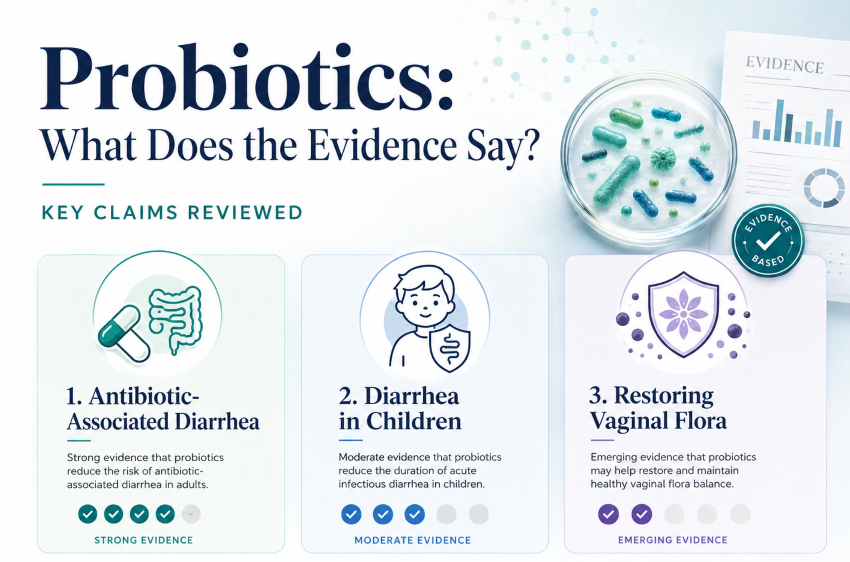
Evidence confidence varies by condition. The supplied evidence includes large meta-analyses and randomised controlled trials, but it does not support a blanket verdict for all probiotics. The clearest positive signal is prevention of antibiotic-associated diarrhoea in studied settings. The clearest negative signal is childhood acute gastroenteritis for the tested Lactobacillus-based products.
Evidence at a glance
Irritable bowel syndrome
Average symptom scores improve in meta-analyses, but results vary across strains and trials.
Antibiotic-associated diarrhoea
Pooled randomised evidence shows fewer cases when probiotics are used with antibiotics.
Bacterial vaginosis
Selected preparations may improve short-term cure or reduce recurrence after standard treatment.
Childhood acute gastroenteritis
Two large trials found no benefit from the tested products on severity or symptom duration.
H. pylori treatment
Some preparations may improve eradication rates when added to standard therapy, not when used alone.
What “probiotic” actually means here
Probiotic studies test specific live microorganisms, often identified by strain, in a defined dose and product. Different products can contain different organisms or mixtures. That makes “Do probiotics work?” more like asking whether medicines work than asking whether one medicine works for one condition.
The practical evidence question is narrower: does this preparation help this group of people with this outcome?
What the best supplied evidence says
PlausibleIBS: modest average benefit, high product uncertainty
A 2023 meta-analysis of randomised trials involving 8,581 participants reported improvements in global IBS symptoms, abdominal pain and quality of life. A 2020 meta-analysis of 3,452 participants also found fewer persistent symptoms, although average improvements in pain and bloating were smaller. [1] [2]
A 362-person dose-finding trial found benefit with one dose of Bifidobacterium infantis 35624 in women with IBS. This is evidence for that studied preparation and dose, not for every product labelled “probiotic.” [3]
SupportedAntibiotic-associated diarrhoea: fewer cases in pooled trials
A 2012 meta-analysis covering 11,811 participants reported a relative risk of 0.58 and an estimated number needed to treat of 13. A 2021 adult meta-analysis covering 11,305 participants reported a relative risk of 0.63. [4] [5]
An older 135-person inpatient trial also reported fewer cases of antibiotic-associated diarrhoea with its tested fermented milk preparation. The pooled conclusion is stronger than any claim about an individual commercial product. [6]
PlausibleBacterial vaginosis: possible benefit, mainly as an adjunct
A phase 2b randomised trial of 228 women found lower recurrence after standard metronidazole treatment with vaginal Lactobacillus crispatus CTV-05 than with placebo. Meta-analyses also reported improved short-term cure and lower recurrence across varied probiotic approaches. [7] [8] [9]
These findings do not establish that any oral or vaginal probiotic can replace standard treatment. Preparations and treatment pathways differed across studies.
Not supportedChildhood acute gastroenteritis: large modern trials were negative
A US trial of 971 children found no reduction in moderate-to-severe gastroenteritis or diarrhoea duration with Lactobacillus rhamnosus GG. A Canadian trial of 886 children found no benefit from a combination of L. rhamnosus and L. helveticus. [10] [11]
An updated Cochrane review found no clear difference in diarrhoea lasting at least 48 hours after excluding studies at high risk of bias. This updates the older, more favourable review. [12]
Plausible adjunctH. pylori: possible improvement alongside eradication therapy
A 2025 network meta-analysis of 91 randomised trials and 13,680 participants found higher eradication odds when probiotics were added to standard regimens. An earlier strain-mixture analysis also reported benefit for some combinations. [13] [14]
The evidence supports a possible adjunct role. It does not support probiotics as a stand-alone way to eradicate H. pylori, and the size of benefit may differ by mixture and treatment regimen.
What this evidence does not prove
- That all probiotic products are interchangeable.
- That a positive result in one condition predicts benefit in another.
- That a multi-strain product is better simply because it contains more strains.
- That probiotics replace established treatment for bacterial vaginosis or H. pylori.
- That efficacy evidence is the same as a complete safety assessment.
Key studies
On mobile: swipe sideways to view all columns.
| Source | What it found | Main limitations |
|---|---|---|
| Chen et al., 2023 IBS meta-analysis, N=8,581 | Average improvements in global symptoms, pain and quality of life. | Many preparations and treatment durations; certainty is not uniform. |
| Hempel et al., 2012 AAD meta-analysis, N=11,811 | Lower incidence of antibiotic-associated diarrhoea, RR 0.58. | Trials used varied organisms, products, populations and definitions. |
| Cohen et al., 2020 BV phase 2b RCT, N=228 | Lower recurrence after metronidazole with vaginal L. crispatus CTV-05. | One specific vaginal product after standard therapy; not all probiotics. |
| Schnadower et al., 2018 Childhood gastroenteritis RCT, N=971 | No benefit on moderate-to-severe disease or diarrhoea duration. | Result applies directly to the tested L. rhamnosus GG product and setting. |
| Freedman et al., 2018 Childhood gastroenteritis RCT, N=886 | No benefit on moderate-to-severe disease or diarrhoea duration. | Tested one two-strain combination in emergency-department patients. |
| Tanashat et al., 2025 H. pylori network meta-analysis, N=13,680 | Higher eradication odds when probiotics were added to standard therapy. | Benefit can differ by preparation, strain mixture and eradication regimen. |
Bottom line
Frequently asked questions
Do probiotics help irritable bowel syndrome?
They may improve overall symptoms and abdominal pain for some people, but effects vary across strains, products and treatment durations. A positive average result does not mean every probiotic will work.
Can probiotics prevent antibiotic-associated diarrhoea?
Large meta-analyses found fewer cases when probiotics were used with antibiotics. The result is strongest for the studied preparations and settings, not for every product.
Do probiotics treat bacterial vaginosis?
Selected preparations may improve short-term cure or reduce recurrence, especially after standard antibiotic treatment. The evidence does not establish probiotics as a replacement for standard care.
Do probiotics shorten acute gastroenteritis in children?
Two large emergency-department trials found no meaningful benefit from the tested Lactobacillus-based products. An updated Cochrane review also weakened the earlier positive conclusion.
Can probiotics eradicate H. pylori?
Not on their own. Some preparations may improve eradication rates when added to standard treatment, but results depend on the product and regimen.
References
- Chen M et al. Probiotics for irritable bowel syndrome, three-level meta-analysis. PubMed.
- Niu HL and Xiao JY. Probiotics in irritable bowel syndrome, systematic review and meta-analysis. PubMed.
- Whorwell PJ et al. Bifidobacterium infantis 35624 in women with IBS, randomised trial. PubMed.
- Hempel S et al. Probiotics for prevention and treatment of antibiotic-associated diarrhoea, systematic review and meta-analysis. PubMed.
- Goodman C et al. Probiotics for preventing antibiotic-associated diarrhoea in adults, systematic review and meta-analysis. PubMed.
- Hickson M et al. Probiotic preparation and antibiotic-associated diarrhoea in hospital patients, randomised trial. PMC full text.
- Cohen CR et al. Lactobacillus crispatus CTV-05 to prevent bacterial vaginosis recurrence, phase 2b trial. PubMed.
- Wang Z et al. Probiotics and bacterial vaginosis, meta-analysis of randomised trials. PubMed.
- Chieng WK et al. Probiotics and bacterial vaginosis recurrence, systematic review and meta-analysis. PubMed.
- Schnadower D et al. Lactobacillus rhamnosus GG versus placebo for acute gastroenteritis in children. PubMed.
- Freedman SB et al. Combined L. rhamnosus and L. helveticus for acute gastroenteritis in children. PubMed.
- Collinson S et al. Probiotics for treating acute infectious diarrhoea, Cochrane Review update. Cochrane Library.
- Tanashat M et al. Probiotics as adjuncts to H. pylori eradication therapy, network meta-analysis. PubMed.
- McFarland LV et al. Strain-specific probiotic mixtures as adjuncts for H. pylori eradication, systematic review and meta-analysis. PMC full text.
Last reviewed: 8 August 2026.
Disclaimer: This article is for general educational information only and is not medical advice. It does not diagnose, treat, or replace care from a qualified health professional. Always speak with a qualified health professional about personal health questions, medicines, pregnancy, medical conditions, or before changing treatment.