Do Blue-Light Glasses Work?
Evidence review
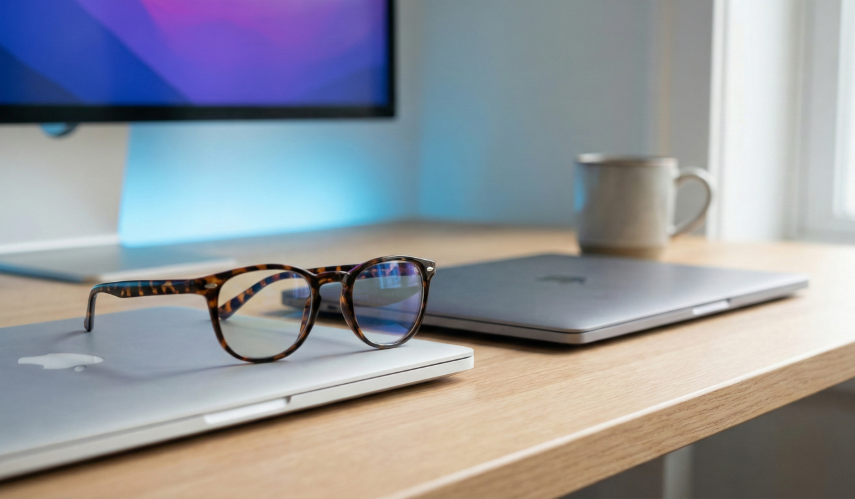
Blue-light glasses are unlikely to reduce digital eye strain or protect your eyes from everyday screen use. Their effect on sleep remains uncertain.
The claim being checked
“Blue-light glasses reduce eye strain, improve sleep and protect the macula from screen damage.”
Evidence at a glance
Digital eye strain
Unlikely. The best review and a well-designed trial found little or no benefit over ordinary clear lenses.
Sleep
Uncertain. Strong amber lenses may help some people, but the trials are small and inconsistent.
Macular protection
Uncertain. No eligible randomised trial in the key review measured macular health.
Why blue light may not be the main problem
Digital eye strain can cause tired eyes, dryness, blurred vision and headaches after long periods of screen use. Blue light is often blamed, but screen discomfort can also relate to reduced blinking, dry eyes, glare, sustained close focusing and an incorrect glasses prescription.[7]
Blue light can influence the body clock in the evening. That makes sleep benefits biologically plausible, but a plausible mechanism does not prove that commercially available glasses improve real-world sleep.
What the best evidence says
Not supported Blue-light glasses reliably reduce digital eye strain
A 2023 Cochrane review included 17 randomised controlled trials. Studies enrolled between 5 and 156 participants and lasted from less than one day to five weeks. Blue-light-filtering lenses may make little or no difference to short-term visual fatigue compared with ordinary lenses. Many studies were small or at risk of bias.[1]
A double-masked trial randomly assigned 120 symptomatic computer users to blue-blocking or clear placebo lenses during a two-hour computer task. The lenses did not improve reported symptoms or an objective visual-fatigue measure.[2]
A 2025 crossover trial in 26 healthy adults also found no meaningful differences in dry-eye symptoms or tear-film measurements across blue-filtering, anti-reflective and ordinary lenses during a two-hour tablet task.[3]
Uncertain Wearing blue-light-blocking glasses before bed improves sleep
The Cochrane review found inconsistent sleep results across six trials involving 148 participants. Three reported improvement and three found no significant difference. The review rated the sleep evidence very low certainty.[1]
A 2025 meta-analysis pooled objective sleep measurements from only three double-blind crossover trials involving 49 participants. It found no statistically significant improvement in time to fall asleep, total sleep time, sleep efficiency or time awake after initially falling asleep.[4]
An earlier review found mixed results and small improvements in some pooled sleep measures. One placebo-controlled trial in 14 adults with insomnia symptoms reported several benefits from strong amber lenses, but it was too small and short to settle the question.[5][6]
Strong amber lenses used in sleep studies can block much more short-wavelength light than nearly clear “computer glasses”. Results should not be assumed to apply to every product.
Uncertain Blue-light glasses protect the macula from everyday screens
The macula is the central area of the retina used for detailed vision. Laboratory experiments using intense light do not show that ordinary screens damage human eyes.
The Cochrane review found no eligible randomised trial that measured macular health, so it could not determine whether blue-light-filtering glasses prevent macular damage.[1]
The American Academy of Ophthalmology states that there is no scientific evidence that computer-screen light damages the eyes and does not recommend special eyewear solely for computer use.[7]
What this does not prove
An evidence gap is not proof that blue-light glasses can never help anyone. It does mean that claims about preventing macular damage are not established.
Sleep results from strong amber lenses also cannot be applied automatically to the nearly clear blue-light-filtering lenses commonly sold for daytime computer use.
What this means for you
Blue-light glasses are not a reliable solution for screen discomfort. Measures that address more likely causes include:
- Taking regular breaks from close work
- Blinking more often
- Reducing glare and excessive screen brightness
- Increasing text size and using a comfortable viewing distance
- Managing dry-eye symptoms
- Checking whether your glasses prescription is current
For sleep, reducing bright evening light, dimming screens and keeping a regular sleep schedule may be more useful than relying on glasses alone.
Safety and practical cautions
Serious harms have not been established, but safety reporting was limited. Trials reported occasional headache, discomfort while wearing the glasses and changes in mood. Strongly tinted lenses can alter colour perception and may be unsuitable when accurate colour recognition is important.[1]
Key studies
On mobile: swipe sideways to view all columns.
| Source | What it found | Main limitations |
|---|---|---|
| Cochrane review, 2023 17 RCTs, N=5 to 156 per trial |
Little or no short-term eye-strain benefit. Sleep results were inconsistent. No trial measured macular health. | Small, varied studies; short follow-up; many studies at risk of bias. |
| Singh et al., 2021 Double-masked RCT, N=120 |
No improvement in symptoms or an objective visual-fatigue measure versus clear lenses. | Single two-hour computer task; short-term outcome. |
| Luna-Rangel et al., 2025 Meta-analysis of 3 crossover RCTs, N=49 |
No statistically significant improvement in four objective sleep outcomes. | Very small evidence base; varied protocols; estimates were imprecise. |
| Heo et al., 2020 Systematic review and meta-analysis, 12 studies |
Mixed findings, with small improvements in some pooled sleep measures. | Different populations, filters and outcomes; limited controlled evidence. |
| Shechter et al., 2018 Randomised crossover trial, N=14 |
Strong amber lenses improved several reported sleep outcomes and one objective measure. | Very small sample; one week per condition; adults with insomnia symptoms. |
Bottom line
Blue-light glasses are not a reliable treatment for digital eye strain. Strong amber lenses worn before bed may help some people, but the sleep evidence remains small and mixed. There is no good human evidence that blue-light glasses protect the macula from everyday screen exposure.
Frequently asked questions
Do blue-light glasses stop headaches?
Can blue-light glasses prevent eye damage?
Can blue-light glasses help you sleep?
Are all blue-light glasses the same?
No. Products differ in the wavelengths and proportion of light they filter. Nearly clear computer lenses may block much less short-wavelength light than the amber lenses used in some sleep studies.[1]
Are blue-light glasses the same as UV-blocking sunglasses?
No. Blue light is visible light. Ultraviolet radiation is outside the visible spectrum and is a separate issue in outdoor eye protection.
References
- Singh S, Keller PR, Busija L, et al. Blue-light filtering spectacle lenses for visual performance, sleep, and macular health in adults. Cochrane Database of Systematic Reviews. 2023. PubMed PMID 37593770.
- Singh S, Downie LE, Anderson AJ. Do Blue-blocking Lenses Reduce Eye Strain From Extended Screen Time? A Double-Masked Randomized Controlled Trial. American Journal of Ophthalmology. 2021. PubMed PMID 33587901.
- Effect of blue-filtering lens spectacles on signs and symptoms of dry eye during exposure to a digital screen. Randomised crossover trial. 2025. PubMed PMID 40521793.
- Luna-Rangel FA, Gonzalez-Bedolla B, Salazar-Ortega MJ, et al. Efficacy of blue-light blocking glasses on actigraphic sleep outcomes: a systematic review and meta-analysis of randomized controlled crossover trials. Frontiers in Neurology. 2025. PubMed PMID 41341515.
- Heo JY, Kim K, Fava M, et al. Interventions to reduce short-wavelength (“blue”) light exposure at night and their effects on sleep: a systematic review and meta-analysis. Sleep Advances. 2020. PubMed PMID 37192881.
- Shechter A, Kim EW, St-Onge MP, Westwood AJ. Blocking nocturnal blue light for insomnia: a randomized controlled trial. Journal of Psychiatric Research. 2018. PubMed PMID 29101797.
- American Academy of Ophthalmology EyeWiki. Computer Vision Syndrome (Digital Eye Strain). Read the clinical overview.
Disclaimer: This article is for general educational information only and is not medical advice. It does not diagnose, treat, or replace care from a qualified health professional. Always speak with a qualified health professional about personal health questions, medicines, pregnancy, medical conditions, or before changing treatment.