Can AI Smart Glasses Damage Your Eyes?
Evidence review
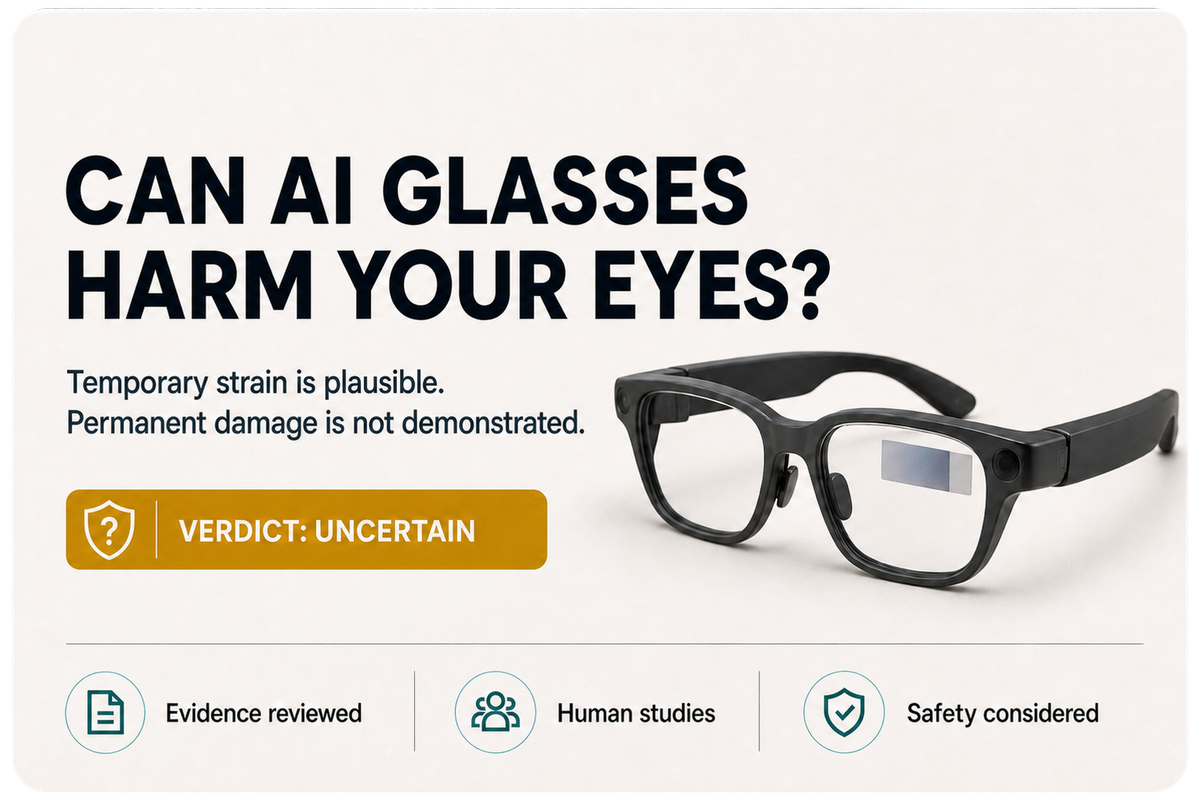
Display-equipped AI glasses can cause temporary eye strain, glare and focusing changes. Permanent eye damage has not been demonstrated, but long-term studies are too limited to settle the question.
The claim being checked
“AI smart glasses damage your eyes because a tiny screen sits extremely close to them.”
Evidence at a glance
Temporary symptoms
Supported. Short studies report fatigue, discomfort, blur and temporary changes in focusing or eye coordination.
Permanent damage
Uncertain. Lasting retinal or visual damage has not been demonstrated, but long-term research is sparse.
The main issue
Display design matters. Monocular rivalry, fixed-focus optics, glare, poor fit and prolonged use matter more than AI itself.
Is the screen really focused a few centimetres from your eye?
Usually, no. The physical microdisplay may sit inside the frame, but lenses or waveguides create a magnified virtual image at a much greater optical distance. The eye cannot focus on a display panel only millimetres away. It focuses at the virtual image distance set by the optics instead.[9]
For example, Microsoft describes the HoloLens display as having a fixed optical distance of about two metres. That means the physical closeness of the electronics is not, by itself, evidence of eye damage.[10]
The better question is not “How close is the screen?” It is “What optical image reaches the eye, how are the two eyes being asked to work, how bright and stable is the image, and how long is it used?”
How display glasses can disturb normal vision
Accommodation is the eye’s focusing response. Vergence is the coordinated turning of both eyes so they point at the same target. These responses normally work together.
Many binocular augmented-reality displays keep accommodation fixed at one optical distance while using separate images to make an object appear nearer or farther away. This mismatch is called vergence-accommodation conflict. It can increase visual effort, reduce comfort and temporarily alter focusing or eye-coordination measurements.[1][4]
A monocular display creates a different problem. One eye sees the digital overlay while the other does not. The brain must reconcile the unequal images, sometimes producing interocular conflict, distraction or discomfort. Bright overlays can also create glare, especially in dim surroundings.[7]
Concentrated screen use may also reduce complete blinking and worsen dryness, burning or irritation. Uncorrected vision, presbyopia, dry eye and existing accommodation or binocular-vision problems may make symptoms more noticeable.[8]
What the best evidence says
Not supported Physical screen proximity proves that the glasses damage the eye
Near-eye optics form a virtual image at a distance the eye can focus on. The physical position of the microdisplay does not tell us the eye’s focusing demand or retinal exposure.[9]
The relevant factors include virtual focal distance, whether one or both eyes receive an image, image alignment, brightness, contrast, resolution, flicker, field of view, prescription correction and exposure time.
Supported Near-eye displays can cause temporary visual fatigue and focusing changes
A 2026 scoping review included 43 human extended-reality studies, including 14 augmented-reality studies. Short-term exposure was repeatedly associated with changes in accommodation, convergence and subjective discomfort. Where recovery was measured, most changes resolved within minutes to hours of rest.[1]
In 54 adults, a 40-minute binocular augmented-reality simulator session temporarily moved the near points of focusing and convergence farther away and increased discomfort. A smaller study of 16 young adults found temporary accommodation and eye-coupling changes after an augmented-reality task but not after the corresponding physical task.[3][4]
These findings describe fatigue or adaptation after use. They do not demonstrate injury to the eye.
Uncertain Daily smart-glasses use causes lasting deterioration or retinal damage
The 2026 review found only eight studies of prolonged, repeated or longitudinal exposure. Most participants were young and healthy, devices and tasks differed substantially, and the review did not formally rate the risk of bias of individual studies.[1]
The most directly relevant workplace study followed users of monocular smart glasses for six months. It found no statistically significant deterioration in near or distance visual acuity. However, only 17 of the original 43 workers completed follow-up, there was no control group, and many participants reported fatigue, burning or other strain symptoms.[2]
Current evidence therefore cannot confirm a cumulative injury, but it is too weak to establish the safety of years of frequent use across all modern devices.
Supported Some designs can obstruct, degrade or compete with normal vision while worn
A very small JAMA study found that Google Glass hardware created a meaningful upper-right visual-field obstruction in all three tested users, even with the software switched off. A separate two-person experiment found reduced contrast sensitivity in the display eye, particularly under dim conditions.[6][7]
These studies are too small and too device-specific for broad estimates of risk. They do show that fit, optical placement, glare and hardware design can interfere with vision independently of permanent eye health.
Not all AI glasses pose the same visual demands
- Camera and audio glasses without a display do not create a near-eye virtual image. Their AI functions are not an eye exposure by themselves.
- Monocular display glasses show information to one eye. Their main concerns include unequal images between the eyes, glare, distraction and display placement.
- Binocular augmented-reality glasses can add vergence-accommodation conflict and depth-perception errors if virtual depth cues do not match the fixed focus plane.
- Fully immersive virtual-reality headsets block the real world and add visual-motion conflicts. Evidence from these headsets should not be treated as direct evidence about lightweight, see-through glasses.
“AI glasses” is therefore too broad a category for a single safety claim. The AI software is mostly irrelevant to eye physiology. The display optics, fit and pattern of use are what matter.
What this does not prove
Temporary fatigue does not mean that retinal cells or eye muscles are being permanently damaged. Symptoms such as tired eyes, dryness, headache or brief difficulty refocusing can occur without structural injury.
At the same time, one small six-month study cannot establish the safety of all-day use over many years. Current research has not adequately studied children, older adults, people with eye disease, people with significant prescriptions or users with binocular-vision disorders.
Claims that compliant consumer displays burn the retina through ordinary use are not supported by the supplied human evidence. Claims that every display-equipped product is completely safe are also stronger than the evidence allows.
What this means for you
Comfort is likely to vary between people and products. Sensible ways to reduce visual load include:
- Use the correct prescription lenses or inserts when required
- Make sure the display is properly aligned and the frame fits securely
- Keep brightness appropriate for the surroundings rather than automatically using the maximum
- Use the visual display intermittently and take regular breaks during sustained tasks
- Blink fully and address persistent dry-eye symptoms
- Stop using the display if it produces persistent blur, double vision, eye pain, marked headache or dizziness
Ongoing symptoms warrant an eye examination to check prescription, dry eye, focusing ability and how the eyes work together.[8]
Safety and practical cautions
Visual comfort and public safety are separate from permanent eye damage. A display can distract you, hide part of the visual field or reduce contrast without injuring the eye. Avoid reading notifications or other detailed content while driving, cycling, crossing roads or performing safety-critical work.[6][11]
Key studies
On mobile: swipe sideways to view all columns.
| Source | What it found | Main limitations |
|---|---|---|
| Räppo et al., 2026 Scoping review, 43 human studies |
XR exposure was often followed by temporary accommodation, convergence and discomfort changes. Most measured recovery occurred within minutes to hours. | Only 14 AR studies; few longitudinal studies; heterogeneous devices and outcomes; no formal risk-of-bias assessment. |
| Herold et al., 2024 Workplace observational study, N=43; six-month follow-up N=17 |
No significant deterioration in near or distance visual acuity over six months. Eye fatigue, burning and rubbing were commonly reported. | No control group; 60.5% follow-up loss; specialised workplace tasks; subjective symptoms had missing responses. |
| Panke et al., 2025 Single-group pre/post study, N=54 |
A 40-minute binocular AR simulator session temporarily reduced near focusing and convergence performance and increased discomfort. | No non-headset control; immediate outcomes only; specialised simulator users. |
| Yego et al., 2025 AR versus physical task, N=16 |
Temporary changes in tonic accommodation and convergence-accommodation coupling occurred after the AR task, but not the physical task. | Very small, young sample; short exposure; no long-term follow-up. |
| Wang et al., 2023 Within-person AR study, N=30 |
One hour of 2D or 3D viewing produced slight discomfort and changes in blinking or tear-film measures. | Small, healthy young sample; short exposure; no persistent-injury assessment. |
| Ianchulev et al., 2014 Google Glass visual-field study, N=3 |
The frame and display hardware produced an upper-right visual-field obstruction while worn. | Extremely small study of an older product; tested obstruction, not long-term eye health. |
| Longley and Whitaker, 2016 Google Glass contrast study, N=2 |
Contrast sensitivity fell in the display eye, particularly in dim conditions. | Only two participants; older monocular device; cannot estimate frequency or clinical risk. |
Bottom line
Display-equipped AI glasses can temporarily strain or interfere with vision, but permanent eye damage has not been demonstrated. The physical closeness of the microdisplay is not the main issue because the optics create a virtual image farther away. The long-term safety of frequent, everyday use remains uncertain because the available human studies are small, short and highly device-specific.
Frequently asked questions
Is the display actually focused right in front of the eye?
Usually not. The physical microdisplay may be close, but the optical system forms a virtual image at a greater distance. Your eye focuses on that virtual image rather than on the tiny panel inside the frame.[9]
Can AI smart glasses permanently damage the retina?
Permanent retinal damage from ordinary use has not been demonstrated in the supplied human evidence. However, long-term studies of modern consumer display glasses are too limited to establish the safety of years of frequent use.
Why can display glasses cause eye strain?
Are one-eye displays worse than two-eye displays?
They create different problems. A one-eye display can cause interocular conflict because the eyes receive unequal images. A two-eye display can create vergence-accommodation conflict if simulated depth does not match the fixed optical focus. Current evidence does not establish that one design is universally safer.
Do AI glasses without a visual display affect the eyes in the same way?
No. Camera and audio glasses without a visual overlay do not create a near-eye virtual image. Ordinary issues such as prescription accuracy, lens quality, fit and frame obstruction may still matter.
What should I do if smart glasses cause blur or headaches?
Stop using the display and allow your eyes to recover. Persistent blur, double vision, eye pain, marked headache or dizziness should be assessed by an optometrist or ophthalmologist, particularly if symptoms recur with short periods of use.
References
- Räppo D, Pizzagalli SL, Argus M, Pladere T. Near-eye displays and visual aftereffects: a scoping review. Frontiers in Virtual Reality. 2026. doi:10.3389/frvir.2026.1842587.
- Herold R, Gevorgyan H, Damerau LS, et al. Effects of Smart Glasses on the Visual Acuity and Eye Strain of Employees in Logistics and Picking: A Six-Month Observational Study. Sensors. 2024;24:6515. doi:10.3390/s24206515.
- Panke K, Karelska E, Alksnis R, Krumina G, Pladere T. Vision functionality and user comfort following the use of binocular indirect ophthalmoscope simulator. Clinical and Experimental Optometry. 2025;108(3):327-335. PubMed PMID 40068970.
- Yego WK, Gilson SJ, Baraas RC, Svarverud E. Adaptive Responses of Accommodation and Vergence Following Exposure to Augmented Reality in a Head-Mounted Display. Investigative Ophthalmology & Visual Science. 2025;66(12):1. PubMed PMID 40891784.
- Wang X, Liu L, Hu X, et al. Comparison of changes in visual fatigue and ocular surface after 3D and 2D viewing with augmented reality glasses. Displays. 2023;78:102401. doi:10.1016/j.displa.2023.102401.
- Ianchulev T, Minckler DS, Hoskins HD, et al. Wearable Technology With Head-Mounted Displays and Visual Function. JAMA. 2014;312(17):1799-1801. doi:10.1001/jama.2014.13754.
- Longley C, Whitaker D. Google Glass Glare: disability glare produced by a head-mounted visual display. Ophthalmic and Physiological Optics. 2016;36(2):167-173. doi:10.1111/opo.12264.
- American Academy of Ophthalmology EyeWiki. Computer Vision Syndrome (Digital Eye Strain). Read the clinical overview.
- Optimizing virtual reality for all users through gaze-contingent and adaptive focus displays. Proceedings of the National Academy of Sciences. 2017. PubMed PMID 28193871.
- Microsoft Learn. Comfort: Mixed Reality. Read the display-comfort guidance.
- American Optometric Association. 4 patient questions about Google Glass. Read the eye-care commentary.
Disclaimer: This article is for general educational information only and is not medical advice. It does not diagnose, treat, or replace care from a qualified health professional. Always speak with a qualified health professional about personal health questions, medicines, pregnancy, medical conditions, or before changing treatment.