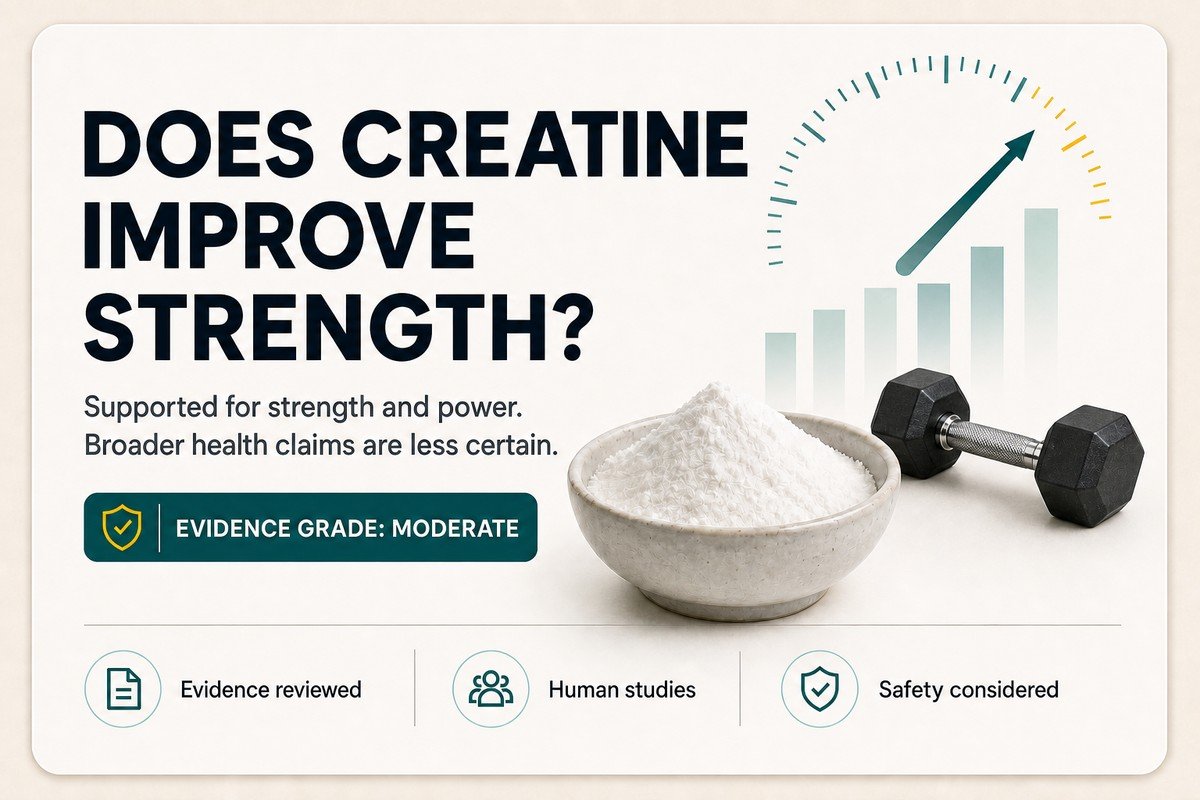
Does creatine monohydrate improve strength?
Creatine has real evidence behind it. The benefit is narrower than the online hype suggests.
Good evidence for short-burst performance. Not a general anti-aging or brain-health supplement.
Creatine monohydrate can modestly improve strength, power, and repeated short-burst exercise, especially when paired with resistance training. It is not well supported as a standalone muscle-builder, endurance booster, anti-aging supplement, or proven brain-health treatment.
The claim
“Creatine monohydrate improves strength, muscle performance, and other health outcomes.”
This claim is partly true, but it needs boundaries. Creatine monohydrate has the strongest evidence for short, intense physical efforts such as lifting weights, repeated sprints, and resistance-training performance.1
The evidence gets weaker when the claim shifts to endurance, anti-aging, or broad brain health. WEH would not frame creatine as a cure-all supplement.
At a glance
Strength and power outcomes
Older adults with exercise training
Memory and brain-health claims
Endurance and anti-aging hype
WEH evidence rating
WEH interpretation: moderate evidence supports creatine monohydrate for strength and power performance, especially alongside resistance training. Evidence is weaker for cognition and broader health claims.
What the best evidence says
Press the arrow for more details. Each evidence card expands to show the result, limits, and WEH interpretation.
Supported
Creatine helps short, intense exercise more than endurance exercise
Source type: NIH health professional evidence summary
v
Creatine helps short, intense exercise more than endurance exercise
The NIH Office of Dietary Supplements says creatine helps supply energy for short-term, mostly anaerobic activity. Anaerobic means the effort relies heavily on quick energy systems rather than long-duration oxygen-based endurance metabolism.1
The same source says numerous clinical trials generally show benefit for high-intensity, intermittent activity, with possible increases in strength, power, and maximal-effort work. It also says creatine has little value for endurance sports.1
Supported
Meta-analyses support upper and lower limb strength benefits
Study type: systematic reviews and meta-analyses of randomized trials
v
Meta-analyses support upper and lower limb strength benefits
A 2015 systematic review and meta-analysis included 60 randomized controlled trials, with 646 people taking creatine and 651 controls. It found significant benefits for squat, leg press, quadriceps, and global lower-limb strength outcomes.2
A 2016 systematic review and meta-analysis included 53 studies, with 563 people taking creatine and 575 controls. It found significant benefits for bench press, chest press, pectoral strength, and global upper-limb strength.3
Supported but modest
Older adults may get a small extra benefit when creatine is paired with training
Study type: meta-analysis of older-adult resistance training trials
v
Older adults may get a small extra benefit when creatine is paired with training
A 2014 meta-analysis included 10 studies with 357 older adults. Creatine plus resistance training improved fat-free mass, leg press, chest press, and a 30-second chair-stand test compared with resistance training alone.4
This suggests creatine may add a small benefit to training in older adults. It does not show that creatine alone prevents frailty, falls, fractures, or aging.
Uncertain
Brain and memory claims are interesting, but not settled
Study type: systematic review and meta-analysis of randomized controlled trials
v
Brain and memory claims are interesting, but not settled
A 2023 systematic review and meta-analysis looked at memory in healthy people. It included 10 randomized controlled trials in the review and 8 trials in the meta-analysis, with 225 participants in the pooled analysis.5
The review found a small overall memory benefit and a larger signal in older adults. But the evidence was small and varied between studies, so it should not be used to claim creatine is a proven brain-health supplement.5
Not supported
Endurance, anti-aging, and “muscle without training” claims overreach
Study type: evidence summary and absence of supplied direct support
v
Endurance, anti-aging, and “muscle without training” claims overreach
The evidence reviewed here does not support creatine as a reliable endurance supplement. The NIH evidence summary says it appears to have little value for endurance sports, and weight gain from water retention may work against some endurance goals.1
The evidence reviewed here also does not prove that creatine slows aging, prevents disease, or builds useful muscle without exercise.
Key studies
The most useful evidence comes from systematic reviews, meta-analyses, randomized trials, and an official NIH supplement summary.
A randomized controlled trial, or RCT, randomly assigns people to an intervention or comparison group. Meta-analyses pool results across studies, but their conclusions still depend on the quality and consistency of the included trials.
| Source | WEH limitations note |
|---|---|
NIH Office of Dietary Supplements1 |
Secondary summary. Useful for broad evidence context, but not a single trial. |
Lanhers 2015 lower-limb meta-analysis2 |
Focused on lower-limb strength performance, not general health outcomes. |
Lanhers 2016 upper-limb meta-analysis3 |
Focused on upper-limb strength performance. Does not prove endurance or anti-aging claims. |
Devries and Phillips 2014 older-adult meta-analysis4 |
Benefit was seen with resistance training. Small number of studies and some heterogeneity. |
Prokopidis 2023 memory meta-analysis5 |
Small evidence base with variable results. Not enough for broad brain-health claims. |
Are results consistent across studies?
The strength and power signal is fairly consistent across the evidence reviewed here. That is where creatine monohydrate looks most credible.
The benefit is narrower for older adults. The evidence supports creatine as an add-on to training, not as a replacement for training.
The brain-health signal is much less consistent. WEH should describe it as preliminary rather than proven.
Safety note
Creatine commonly increases body weight through water retention. The NIH fact sheet also lists anecdotal reports of nausea, diarrhea, muscle cramps, muscle stiffness, and heat intolerance.1
The evidence reviewed here suggests few safety concerns in healthy adults at typical doses. That does not justify saying creatine is safe for everyone.
People with kidney disease, complex medical conditions, pregnancy, or adolescent supplement use should get clinician advice before using creatine. The evidence reviewed here does not provide enough detail to make a stronger safety claim for these groups.
Supplement quality also matters. Dietary supplements are not regulated like prescription medicines.
What this means for you
If you already do resistance training, creatine monohydrate may provide a small extra strength or power benefit. If you do not train, the evidence does not support treating creatine as a shortcut to useful muscle gain.
The cleanest evidence-based statement is: creatine monohydrate can help with short-burst strength and power performance. Claims about anti-aging, endurance, and brain health need much more caution.
What we still do not know
The strongest evidence is for strength and power performance. The evidence is less settled for memory, cognition, healthy aging, and disease prevention.
Future updates should check whether newer trials or meta-analyses change the size of benefit, safety picture, or confidence rating.
Creatine also has a supplement-market problem: product quality, dose, and marketing claims can vary. This post assesses creatine monohydrate evidence, not any specific brand.
Frequently asked questions
Does creatine monohydrate help build strength? v
Does creatine work without exercise? v
The evidence does not support using creatine as a shortcut to useful muscle gain without training. The clearest older-adult evidence was for creatine paired with resistance training.4
Does creatine improve endurance? v
Not reliably. The NIH evidence says creatine appears to have little value for endurance sports such as distance running or swimming.1
Does creatine improve memory or brain health? v
A 2023 review found a small memory signal, especially in older adults, but the pooled evidence was small and varied between studies.5 WEH should not call creatine a proven brain-health supplement based on these trials.
Is creatine monohydrate safe? v
The evidence reviewed here suggests few safety concerns in healthy adults at typical doses, but weight gain from water retention is common.1 People with kidney disease or complex medical conditions should discuss it with a clinician.
Sources
- NIH Office of Dietary Supplements. Dietary Supplements for Exercise and Athletic Performance: Health Professional Fact Sheet. Official evidence summary.
- Lanhers C, et al. Creatine Supplementation and Lower Limb Strength Performance: A Systematic Review and Meta-Analyses. Sports Medicine. 2015. Systematic review and meta-analysis.
- Lanhers C, et al. Creatine Supplementation and Upper Limb Strength Performance: A Systematic Review and Meta-Analysis. Sports Medicine. 2016/2017. Systematic review and meta-analysis.
- Devries MC, Phillips SM. Creatine Supplementation during Resistance Training in Older Adults: A Meta-analysis. Medicine & Science in Sports & Exercise. 2014. Meta-analysis.
- Prokopidis K, et al. Effects of creatine supplementation on memory in healthy individuals: a systematic review and meta-analysis of randomized controlled trials. Nutrition Reviews. 2023. Systematic review and meta-analysis.