Minoxidil for Hair Loss: Proven Help, Not a Cure
Minoxidil for hair loss: proven help, not a cure
Minoxidil has real evidence for pattern hair loss. But “works for some people” is not the same as a cure, a guarantee, or proof for every kind of hair loss.
Strong for topical minoxidil in pattern hair loss; cautious for oral minoxidil; not established for all hair-loss causes.
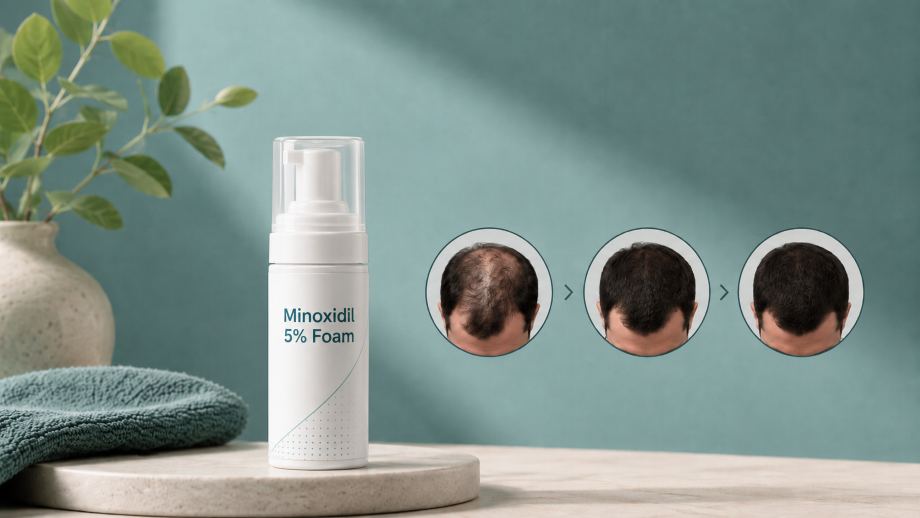
Minoxidil is one of the better-supported hair-loss treatments, but mainly for male and female pattern hair loss. It can help maintain hair and produce some regrowth in some people, but results are slow, partial, variable, and usually depend on continued use.
The claim
“Minoxidil regrows hair.”
This claim is supported with important limits. A better question is: which kind of hair loss, which form of minoxidil, and what outcome?
The evidence is strongest for androgenetic alopecia, also called male or female pattern hair loss. It is not proof that minoxidil works for every type of shedding, every body area, or every person.1
At a glance
Topical minoxidil for male and female pattern hair loss
Slow, partial, variable results that usually need ongoing use
Oral minoxidil is not clearly better overall in current trial evidence
All hair-loss causes, beard claims, eyebrow claims, or scarring hair loss
WEH evidence rating
Minoxidil has a real evidence base, but the claim is often stretched. The strongest support is for topical minoxidil in androgenetic alopecia. The evidence is more cautious for oral minoxidil and does not establish minoxidil as a universal hair-regrowth treatment.
What the best evidence says
Press the arrow for more details.
Topical minoxidil can help pattern hair loss
Randomized trials have tested topical minoxidil in men and women with pattern hair loss, and FDA regulatory records support topical use in this setting.2347
Oral minoxidil is not clearly better overall
In the 2024 randomized trial in men with androgenetic alopecia, oral minoxidil did not show overall superiority over topical minoxidil at 24 weeks. Unwanted hair growth and headache were more common with oral treatment.8
All-purpose hair-growth claims go beyond the evidence
Current clinical evidence does not establish minoxidil as a treatment for every form of hair loss, including sudden shedding, patchy hair loss, scarring or inflammatory hair loss, or eyebrow growth claims.
For beard or facial hair, minoxidil has limited but emerging evidence for improving density, especially in trans men using testosterone, but this is best described as facial hair enhancement, not proven treatment for all beard hair loss. It is not established for alopecia barbae, patchy autoimmune beard loss, scarring, inflammatory, infectious, or unexplained beard hair loss.91011
Key studies
The most useful evidence comes from randomized trials, review evidence, clinical guidance, regulatory context, and a recent oral-versus-topical comparison trial.
A randomized controlled trial, or RCT, randomly assigns people to treatment or comparison groups. It is usually better than before-and-after photos for testing whether a treatment caused a hair outcome.
| Source | WEH limitations note |
|---|---|
American Academy of Dermatology hair loss treatment information1 |
Useful clinical context, but not a single trial. |
Olsen et al., 20022 |
Applies to androgenetic alopecia, not every hair-loss cause. |
Olsen et al., 20073 |
Does not support guaranteed or permanent regrowth claims. |
Lucky et al., 20044 |
Condition-specific evidence; does not cover all shedding causes. |
Cochrane review: female pattern hair loss treatments5 |
Review-level evidence, but still specific to female pattern hair loss. |
Australian Prescriber, 20256 |
Secondary clinical review; useful for context and safety framing. |
FDA approval letter7 |
Regulatory approval does not mean universal effectiveness. |
Oral minoxidil vs topical minoxidil trial8 |
Did not show overall superiority at 24 weeks; oral side effects differed. |
Are results consistent across studies?
The evidence is consistent enough to support topical minoxidil for pattern hair loss. It is also consistent in showing that the benefit is not a guaranteed cure.
The evidence is less settled for oral minoxidil as a broad replacement for topical treatment, and it does not justify treating minoxidil as an all-purpose answer for unexplained hair loss.
Safety note
Topical minoxidil can cause scalp irritation, contact dermatitis, temporary shedding early in treatment, and unwanted hair growth if it spreads to other areas.
Oral or sublingual minoxidil has different risks, including postural hypotension, fluid retention, headache, and unwanted hair growth. People with cardiac history should not treat oral minoxidil as a casual hair-growth product; it requires clinician judgment and supervision.68
Hair loss that is sudden, patchy, painful, itchy, inflamed, scaling, rapidly worsening, linked with illness or new medicines, or occurring during pregnancy or breastfeeding should be assessed rather than self-labelled as ordinary pattern hair loss.
What this means for you
Minoxidil is evidence-supported for pattern hair loss, especially as a topical treatment. It should be framed as a possible maintenance treatment, not as a permanent cure or guaranteed regrowth product.
A responsible evidence-based framing is: minoxidil can help some people with male or female pattern hair loss, but diagnosis, expectations, side effects, and continued use matter.
What we still do not know
Current clinical evidence does not establish minoxidil for every hair-loss cause or every body area. It also does not prove that oral minoxidil is clearly better overall than topical minoxidil.
Future evidence needs clearer diagnosis, patient-relevant outcomes, longer follow-up, and direct comparisons that include both benefit and safety.
Frequently asked questions
It can help some people with pattern hair loss regrow or retain some hair. It is not a guaranteed full-regrowth treatment.
No clear advantage has been shown. A 2024 trial did not show oral minoxidil was clearly superior overall to topical minoxidil at 24 weeks, and oral treatment had different side effects.8
No. The evidence is strongest for male and female pattern hair loss. Sudden, patchy, scarring, inflammatory, painful, itchy, or rapidly worsening hair loss is a different question and should not be assumed to be ordinary pattern hair loss.
Sources
- American Academy of Dermatology. Hair loss diagnosis and treatment. Clinical information source.
- Olsen et al. Minoxidil trial evidence in male pattern hair loss. PubMed. Randomized trial evidence.
- Olsen et al. Topical minoxidil formulation trial evidence. PubMed.
- Lucky et al. Minoxidil trial evidence in women with pattern hair loss. PubMed.
- Cochrane. Treatments for female pattern hair loss. Review evidence.
- Australian Prescriber. Male and female pattern hair loss. Clinical review.
- U.S. Food and Drug Administration. Approval letter. Regulatory source.
- JAMA Dermatology. Oral minoxidil vs topical minoxidil trial. Randomized comparison trial.
- Wattanawinitchai K, et al. Topical 3% minoxidil for facial hair enhancement in transmen. PubMed. Randomized, double-blind, placebo-controlled trial.
- Marinelli L, et al. Topical minoxidil and beard growth in transgender assigned female at birth individuals on gender-affirming hormone therapy. PubMed. Small cohort study.
- Wolff H, et al. The diagnosis and treatment of hair and scalp diseases. PubMed. Clinical review.