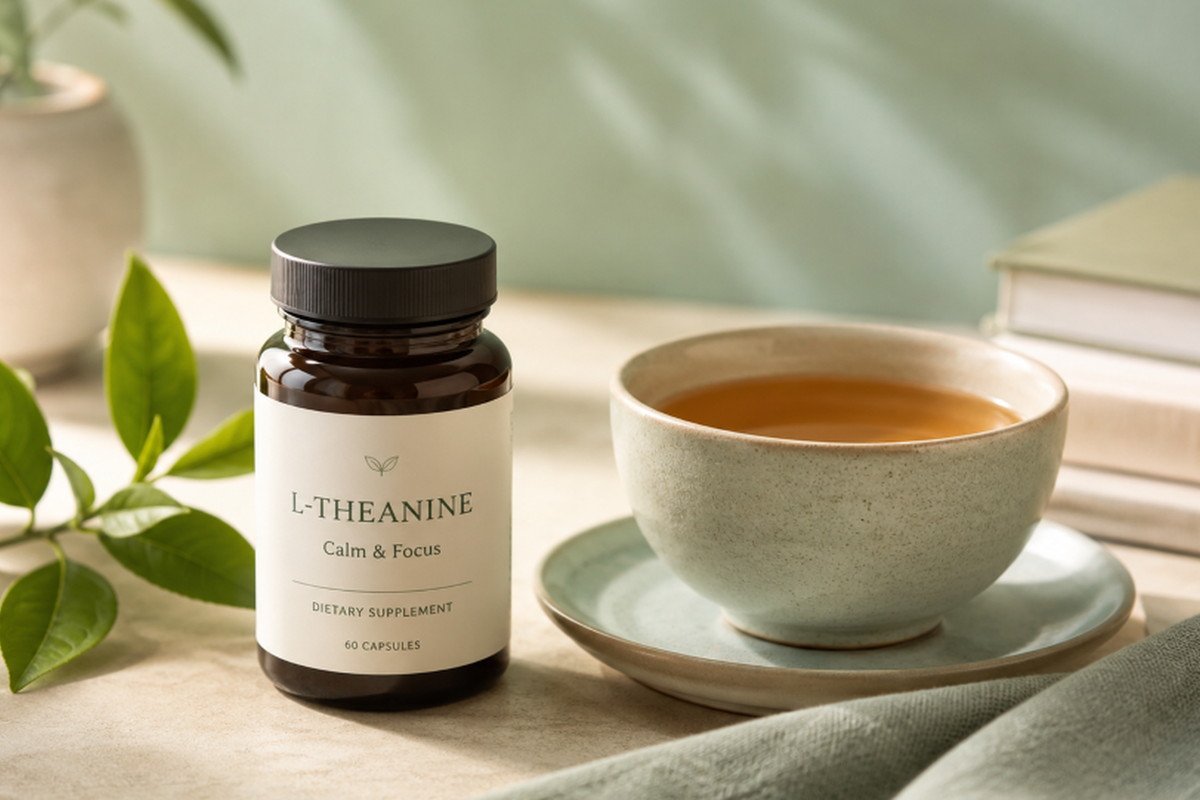
L-theanine: calming supplement or overhyped sleep aid?
WhatEvidence.Health claim check
Claim checked: taking L-theanine improves stress, anxiety, sleep, and focus.
L-theanine may modestly help short-term stress and perceived sleep quality, but it is not proven to treat anxiety disorders, insomnia, ADHD, or poor focus.
L-theanine has promising but not proven evidence for short-term stress relief and subjective sleep quality. The best evidence suggests small benefits in how people feel during stress and how they rate their sleep, but objective sleep and cognition results are weaker. It should not be framed as a proven treatment for anxiety disorders, insomnia, ADHD, or any psychiatric condition.
The claim
“Taking L-theanine improves stress, anxiety, sleep, and focus.”
A better WEH version is: oral L-theanine, usually 200-400 mg per day, improves short-term stress symptoms, sleep quality, and cognitive performance in humans compared with placebo.
That narrower claim matters. Feeling calmer during a stress task is not the same as treating an anxiety disorder, and better sleep questionnaire scores are not the same as curing insomnia.
At a glance
Short-term stress and relaxation
Subjective sleep quality
Focus and cognition
Treatment claims for anxiety disorders, insomnia, ADHD, or psychiatric conditions
WEH evidence rating
There are human randomised controlled trials, meaning people were assigned by chance to L-theanine or a placebo, and there are recent systematic reviews. But many trials are small, short, industry-funded, or use indirect outcomes such as self-rated stress, alpha brain waves, salivary cortisol, or subjective sleep scores.
What the best evidence says
Press the arrow for more details. Each evidence card expands to show the study result, strengths, limits, and WEH interpretation.
Promising
Stress and anxiety: some signal, but not treatment proof
Study type: systematic review of placebo-controlled human RCTs
⌄
Stress and anxiety: some signal, but not treatment proof
A 2020 systematic review of human RCTs found nine placebo-controlled studies of pure L-theanine. Four showed significant reductions in stress or anxiety, but the review concluded that larger and longer studies are needed. The dose range most often discussed was 200-400 mg/day.1
A small 2019 double-blind crossover RCT in 30 healthy adults tested 200 mg/day for four weeks. Compared with placebo, L-theanine improved trait anxiety scores, sleep-quality scores, and some cognitive measures.2
Mixed
Stress markers: indirect outcomes can over-sell the result
Study types: small placebo-controlled stress-task trials
⌄
Stress markers: indirect outcomes can over-sell the result
A 2021 triple-blind crossover RCT tested one 200 mg dose of branded AlphaWave L-theanine in 16 healthy adults during a stress task. It found greater alpha brain-wave activity and lower salivary cortisol than placebo.3
A 2024 RCT tested 400 mg/day for 28 days in 30 adults with moderate stress. Perceived stress fell in both the L-theanine and placebo groups, with no clear between-group advantage for salivary cortisol. Some mood and anxiety measures looked better with placebo than L-theanine.4
Promising
Sleep: subjective scores look better than objective proof
Study types: systematic reviews and meta-analyses
⌄
Sleep: subjective scores look better than objective proof
A 2025 systematic review and meta-analysis included 19 articles and 897 participants. It found small improvements in subjective sleep onset latency, subjective daytime dysfunction, and overall subjective sleep quality, but noted limited evidence for pure L-theanine studies.5
A separate systematic review of standalone L-theanine sleep studies found 13 trials with 550 participants, using 50-900 mg/day. It concluded that 200-450 mg/day appears safe and may support healthy sleep in adults, but several authors were affiliated with British American Tobacco.6
Uncertain
Focus and cognition: pure L-theanine evidence is mixed
Study type: systematic review and meta-analysis of placebo-controlled RCTs
⌄
Focus and cognition: pure L-theanine evidence is mixed
A 2025 meta-analysis of pure L-theanine included only five RCTs and 148 healthy adults. It found a possible dose-dependent improvement in one visual reaction-time outcome, but no significant effect on simple reaction time or Stroop test performance.7
The authors said benefits were not confirmed across all tests and called for larger standardised trials.7
Not supported
Diagnosed anxiety disorders: the key trial was negative
Study type: double-blind placebo-controlled RCT
⌄
Diagnosed anxiety disorders: the key trial was negative
One RCT in generalised anxiety disorder found that L-theanine did not outperform placebo for anxiety reduction or insomnia severity.8
Specialist-only
ADHD and psychiatric conditions: too narrow for wellness claims
Study type: specific-population RCT
⌄
ADHD and psychiatric conditions: too narrow for wellness claims
For children with ADHD, one RCT in 98 boys aged 8-12 found that 400 mg/day for six weeks improved sleep percentage and sleep efficiency on wrist actigraphy, with no significant adverse events.9
Key studies
The linked studies below are the sources supplied in the evidence packet.
| Source | WEH limitations |
|---|---|
Williams et al., 20201 |
Heterogeneous studies; not enough long-term clinical evidence. |
Hidese et al., 20192 |
Small, healthy adults, multiple outcomes, industry funding. |
Evans et al., 20213 |
Very small, acute, surrogate outcomes, industry-funded. |
Moulin et al., 20244 |
Small; placebo response large; funded by Ethical Naturals. |
Bulman et al., 20255 |
Subjective outcomes stronger than objective outcomes; pure L-theanine evidence limited. |
Cotter et al., 20266 |
Several authors were affiliated with British American Tobacco. |
Matyus et al., 20257 |
Small evidence base and heterogeneous preparations. |
Sarris et al., 20198 |
Important negative clinical trial; argues against treatment claims. |
Lyon et al., 20119 |
Narrow population; not ADHD symptom treatment; older study. |
Are results consistent across studies?
The evidence is partly consistent, but not strong. Several small RCTs and reviews point toward a calming or sleep-support signal, especially for subjective outcomes.
The results are weaker when trials use placebo comparison, objective sleep measures, diagnosed anxiety populations, or larger clinical expectations.
The stress evidence is mixed: small acute studies show biological calming markers, but a 2024 28-day trial found similar perceived-stress improvement in both the L-theanine and placebo groups.4
Safety note
Short-term L-theanine was generally well tolerated in the RCTs found. The 2021 AlphaWave trial reported no clinically relevant safety concerns, the 2024 AlphaWave trial reported no clinically relevant adverse results, and the ADHD sleep trial reported no significant adverse events.349
The FDA had no questions about a GRAS notice for L-theanine as a food ingredient, with intended use up to 250 mg per serving in several food categories. That supports food-use safety at notified levels, but it does not prove that L-theanine treats anxiety, insomnia, or cognitive problems.10
L-theanine appears well tolerated in short-term studies, but long-term safety, pregnancy and breastfeeding safety, and product-quality issues are not well established.
People taking sedatives, blood-pressure medicines, psychiatric medicines, or sleep medicines should ask a clinician before using it.
What this means for you
L-theanine may be reasonable to discuss as short-term support for calm or perceived sleep quality, but expectations should stay modest. It is not a substitute for proper care when anxiety, insomnia, ADHD, depression, panic, trauma, or medication side effects are the real issue.
Study doses often fall around 200-400 mg/day, but that is evidence context, not personal dosing advice.
A responsible public claim is: L-theanine may help some people feel calmer during stress and may slightly improve subjective sleep quality. A stronger treatment claim is not justified by this evidence packet.
What we still do not know
We still do not know the best dose, best timing, ideal population, or whether benefits persist beyond a few weeks.
Many studies are small, use different doses, include different populations, and measure outcomes that matter less to readers than real-world sleep, anxiety, or daily functioning.
We also do not know whether pure L-theanine works as well as L-theanine combined with caffeine. Some focus studies may be driven partly by caffeine, so WEH should not attribute all attention benefits to L-theanine alone.
Frequently asked questions
Does L-theanine actually calm you down? ⌄
It may help some people feel calmer during short-term stress. The evidence suggests a signal, but the studies are mostly small and do not prove a large real-world effect.1
Can L-theanine treat anxiety? ⌄
No strong evidence shows that it treats anxiety disorders. The most relevant placebo-controlled trial in generalised anxiety disorder did not show clear benefit for anxiety reduction or insomnia severity.8
Can L-theanine help sleep? ⌄
It may slightly improve self-rated sleep quality in some people. That is not the same as a proven insomnia treatment, and objective sleep evidence is less convincing.5
Does L-theanine improve focus? ⌄
Pure L-theanine evidence is mixed. One meta-analysis found a possible benefit for one visual reaction-time outcome, but not clear benefits across simple reaction time or Stroop testing.7
Is L-theanine safe for everyone? ⌄
No supplement should be treated as safe for everyone. Short-term studies look reassuring, but long-term safety, pregnancy and breastfeeding safety, medication interactions, and product quality remain important gaps.10
Sources
- Williams JL et al. Systematic review of RCTs. Plant Foods for Human Nutrition, 2020. L-theanine and stress/anxiety. View source.
- Hidese S et al. Double-blind placebo-controlled crossover RCT. Nutrients, 2019. L-theanine 200 mg/day for stress, sleep, and cognition in healthy adults. View source.
- Evans M et al. Triple-blind placebo-controlled crossover RCT. Neurology and Therapy, 2021. Single-dose AlphaWave L-theanine and acute stress response. View source.
- Moulin M et al. Randomised placebo-controlled trial. Neurology and Therapy, 2024. AlphaWave L-theanine 400 mg/day for stress and sleep. View source.
- Bulman A et al. Systematic review and meta-analysis. Sleep Medicine Reviews, 2025. L-theanine and sleep outcomes. View source.
- Cotter J et al. Systematic review. Nutritional Neuroscience, 2026. Standalone L-theanine and sleep. View source.
- Matyus RO et al. Systematic review and meta-analysis of placebo-controlled RCTs. Journal of Clinical Medicine, 2025. L-theanine and cognitive function. View source.
- Sarris J et al. Double-blind placebo-controlled RCT. L-theanine for generalised anxiety disorder. View source.
- Lyon MR et al. Randomised controlled trial. L-theanine and sleep quality in boys with ADHD. View source.
- FDA GRAS Notice Inventory. Official regulatory source. GRN No. 209, L-theanine. View source.