Do Topical Exosome Serums Rejuvenate Ageing Skin?
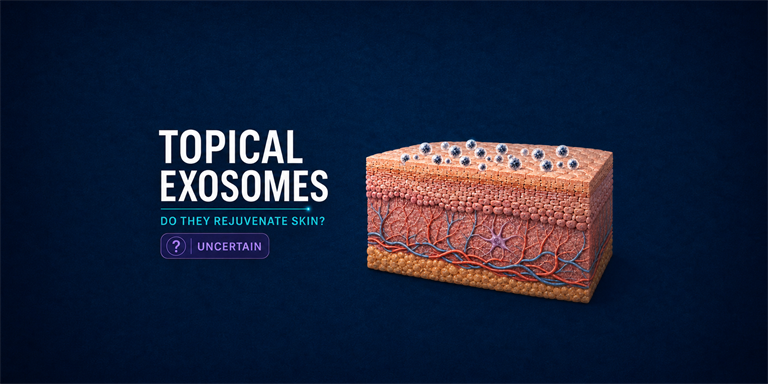
Exosome serums are marketed as tiny cellular messengers that can repair, regenerate and rejuvenate skin. The biology is interesting. The clinical evidence is much less mature.
Early studies suggest possible short-term improvements in wrinkles, pigmentation, hydration and elasticity. But the evidence is low to very low certainty, and much of it tests exosome-containing products after microneedling or laser rather than ordinary serum use on intact skin.
Claim Being Checked
The claim: Topical exosome-containing products reduce wrinkles and other visible signs of facial skin ageing.
Plain-English Summary
Exosomes are small packages released by cells. They can carry proteins, fats and genetic material between cells. However, the International Society for Extracellular Vesicles recommends the broader term extracellular vesicle, or EV, unless researchers have confirmed how a particular vesicle was formed [1].
That distinction matters because “exosome” is not one standard skincare ingredient. Products may be described as coming from platelets, fat-derived stem cells, umbilical tissue, plants or other sources. They may also contain growth factors, peptides and conventional cosmetic ingredients.
A 2026 systematic review of 16 studies involving 503 participants found preliminary signals of benefit for several facial skin outcomes. But most effectiveness results had moderate to critical risk of bias, and the review rated the overall evidence as low or very low certainty [2].
What The Best Evidence Says
UncertainThe overall evidence for facial rejuvenation
The most focused recent review included split-face studies, comparative trials and uncontrolled studies. Most reported improvement in at least one outcome, such as wrinkles, pigmentation, hydration, elasticity or overall appearance [2].
That pattern is encouraging, but it is not conclusive. Study methods, products, procedures and outcome measurements varied substantially. The review found low or very low certainty evidence and concluded that short follow-up and methodological problems prevent firm conclusions.
A broader 2026 meta-analysis also reported pooled improvements in skin and hair outcomes. Its authors noted that small samples, uncontrolled studies, mixed delivery methods, short follow-up and possible publication bias may overestimate benefits [3].
UncertainExosome products added to microneedling
One randomised split-face study enrolled 28 people. Everyone received microneedling. One side of the face also received a human fat-derived stem-cell exosome-containing solution, while the other received saline. The exosome-treated side had better short-term measurements of wrinkles, elasticity, hydration and pigmentation [4].
This was a useful controlled comparison, but it was small and lasted only 12 weeks. It tested a particular product applied with a procedure that creates microchannels in the skin. It does not show that an over-the-counter serum produces the same result on intact skin.
UncertainDaily serum applied to intact skin
A prospective study followed 56 adults using a platelet-derived exosome product for six weeks. Imaging showed improvements from baseline in a composite skin-health score, including wrinkles, redness, pigmentation, luminosity and colour evenness [5].
The study did not include a placebo group. A standardised skincare routine, natural variation, measurement effects or other factors could therefore explain some of the change. The manufacturer partly funded the study, and several authors were employees, founders or consultants of the company.
UncertainCellular ageing markers
A later exploratory study examined skin biopsies from 20 users of the same platelet-derived product. Some cellular-senescence and telomere-damage markers decreased after 12 weeks, particularly among participants who had higher marker levels at baseline [6].
These are laboratory measurements from human skin, not proof that the serum makes someone look younger or produces a lasting health benefit. The study was small and had no placebo group.
UncertainExosomes compared with platelet-rich plasma
In a non-randomised split-face study of 15 participants, both topical fat-derived exosomes and platelet-rich plasma were used after radiofrequency microneedling. Both sides improved, with no significant difference in several outcomes at six months [7].
Without a microneedling-only or vehicle control, the study cannot show how much benefit came from either biological product. It also cannot establish that the treatments are equivalent.
Not supportedClaims that exosome skincare is proven to reverse ageing
The current evidence does not support claims that exosome skincare reverses ageing, repairs DNA, permanently rebuilds skin or works reliably across products. Short-term changes in imaging, rating scales or molecular markers are not the same as proven reversal of biological ageing.
A 2024 systematic review described topical exosome research as preliminary. It included human and animal evidence and found only nine eligible exosome articles, reinforcing how early the field remained at that point [8].
Why “Exosome” On The Label Is Not Enough
An exosome product is not comparable with a standard molecule such as niacinamide. Vesicle contents depend on the source cells, how those cells were grown, how vesicles were isolated, storage conditions, dose and the other ingredients in the final formula.
The term itself may also be used loosely. Expert guidance recommends calling particles extracellular vesicles unless their endosomal origin has been demonstrated [1].
Evidence for one proprietary formula cannot validate every product carrying the word “exosome”. Plant-derived, platelet-derived and stem-cell-derived preparations are not automatically interchangeable.
What This Does Not Prove
- It does not prove that every product marketed as an exosome serum contains well-characterised, intact extracellular vesicles.
- It does not prove that vesicles in every formula penetrate intact human skin and reach the cells claimed in marketing.
- It does not prove that a home serum works like a product applied after microneedling or laser.
- It does not prove that short-term changes in skin measurements last after treatment stops.
- It does not prove that molecular changes amount to visible or clinically meaningful rejuvenation.
- It does not establish the long-term safety of repeated exposure.
Safety And Regulatory Uncertainty
Small clinical studies usually reported mild, temporary effects such as redness, swelling, itching or dryness, with no serious events. However, small and short studies cannot reliably detect uncommon or delayed harm [3].
Microneedling changes the safety question because it creates channels through the skin barrier. The US Food and Drug Administration states that microneedling devices are not approved to deliver cosmetics, topical medicines or other products into the skin, and that the risks of these combinations are unknown [9].
One FDA adverse-event report described generalised itching, hives and angioedema after a product described as synthetic exosomes was applied following microneedling. A single report cannot prove which product or procedure caused the reaction, but it illustrates why intact-skin use and post-procedure delivery should not be treated as equivalent [10].
The FDA says there are currently no FDA-approved exosome products. Its public safety alert concerned unapproved products marketed for treating diseases and included reports of serious adverse events. Those reports should not be misrepresented as proof that ordinary cosmetic serums cause the same harms [11].
In Australia, whether a topical product is regulated as a cosmetic or therapeutic good depends on its composition, intended use and claims. Topical application alone does not settle its regulatory status [12].
Key Studies
On mobile: swipe sideways to view all columns.
| Source | What it found | Main limitations |
|---|---|---|
| Gaebe et al. 2026. Systematic review, 16 studies and 503 participants [2] | Most studies reported improvement in at least one facial skin outcome. | Moderate to critical risk of bias for most effectiveness outcomes; GRADE low or very low. |
| Stack et al. 2026. Systematic review and meta-analysis, 39 skin and hair studies [3] | Pooled results suggested improvements across several aesthetic outcomes. | Small and uncontrolled studies, heterogeneous products and delivery, short follow-up and possible publication bias. |
| Park et al. 2023. Randomised split-face study, N = 28 [4] | Microneedling plus an exosome-containing solution outperformed microneedling plus saline at 12 weeks. | Small and short; tested post-microneedling delivery, not ordinary intact-skin serum use. |
| Proffer et al. 2022. Prospective single-arm study, N = 56 [5] | A platelet-derived product improved several imaging outcomes from baseline after six weeks. | No placebo group; manufacturer funding and multiple author conflicts. |
| Wyles et al. 2024. Exploratory biopsy study, N = 20 [6] | Some senescence and telomere-damage markers improved after 12 weeks. | Small, uncontrolled study; mechanistic markers do not establish visible or lasting benefit. |
| Estupiñán et al. 2025. Non-randomised split-face study, N = 15 [7] | Exosomes and platelet-rich plasma produced similar improvements after radiofrequency microneedling. | No microneedling-only control; extremely small; equivalence was not established. |
| Ash et al. 2024. Systematic review, nine topical exosome articles [8] | Found promising preliminary evidence for skin rejuvenation and wound healing. | Included animal and mechanistic evidence; very limited direct clinical evidence. |
Bottom Line
Topical exosome products are plausible, not proven anti-ageing treatments. Small human studies show possible short-term benefits, especially when a product is applied after microneedling. But product variability, weak controls, short follow-up and industry involvement make it impossible to say that exosome serums as a class reliably rejuvenate skin.
FAQ
Do topical exosome serums work for wrinkles?
Possibly, but the evidence is low to very low certainty. Early studies report wrinkle improvements, yet many are small, uncontrolled or combined with procedures that also affect skin [2].
Do exosomes work better after microneedling?
Can topical exosomes penetrate intact skin?
That has not been established for every product. Formulation, vesicle source, concentration, storage and product testing vary. Clinical improvement from one proprietary product does not prove that all marketed serums deliver intact, active vesicles into human skin.
Are plant exosomes the same as human exosomes?
No. Plant, platelet and stem-cell preparations come from different sources and may carry different material. Expert guidance also recommends the broader term extracellular vesicle unless exosomal origin has been confirmed [1].
Are exosome skincare products FDA approved?
The FDA says there are currently no FDA-approved exosome products [11]. How a product is regulated depends on its contents, intended use and claims.
Are topical exosome treatments safe?
Small studies generally report mild, temporary effects and no serious events, but they are too small and short to establish uncommon or delayed risks. Application after microneedling creates additional uncertainty because it bypasses part of the normal skin barrier.
References
- Welsh JA, et al. Minimal information for studies of extracellular vesicles (MISEV2023): From basic to advanced approaches. Journal of Extracellular Vesicles. 2024.
- Gaebe K, et al. Effectiveness and safety of extracellular vesicle-based therapies for nonsurgical facial rejuvenation: A systematic review. 2026.
- Stack ER, et al. Clinical advances in exosome-based therapies for aesthetic medicine: A systematic review and meta-analysis of human clinical trials. Aesthetic Surgery Journal. 2026.
- Park GH, et al. Human adipose tissue stem cell-derived exosome-containing solution and microneedling for facial skin ageing: A randomised split-face study. Journal of Cosmetic Dermatology. 2023.
- Proffer SL, et al. Efficacy and tolerability of topical platelet exosomes for skin rejuvenation: Six-week results. Aesthetic Surgery Journal. 2022.
- Wyles SP, et al. Topical platelet exosomes reduce senescence signaling in human skin: An exploratory prospective trial. Dermatologic Surgery. 2024.
- Estupiñán B, et al. Adipose mesenchymal stem cell-derived exosomes versus platelet-rich plasma treatment for photoaged facial skin. Journal of Cosmetic Dermatology. 2025.
- Ash M, et al. The innovative and evolving landscape of topical exosome and peptide therapies: A systematic review. Aesthetic Surgery Journal Open Forum. 2024.
- US Food and Drug Administration. Microneedling devices.
- US Food and Drug Administration. MAUDE adverse-event report involving microneedling and synthetic exosomes. 2025.
- US Food and Drug Administration. Public safety alert due to marketing of unapproved stem cell and exosome products.
- Therapeutic Goods Administration. Cosmetics or therapeutic goods: Guidance for advertisers and suppliers. 2024.
Disclaimer
This article is for general educational information only and is not medical advice. It does not diagnose, treat, or replace care from a qualified health professional. Always speak with a qualified health professional about personal health questions, medicines, pregnancy, medical conditions, or before changing treatment.
Applying a topical product after microneedling or another procedure is not equivalent to ordinary use on intact skin and may involve additional risks.