Dopamine Detox
A dopamine detox does not “flush,” “lower,” or “reset” dopamine in the way the phrase is often used online. Dopamine is a normal brain chemical involved in movement, motivation, learning, and reward — not a toxin that can be cleansed. The better-supported version of the claim is narrower: short breaks or limits on smartphone and social media use may modestly improve well-being, mood, or attention for some people, but the evidence is mixed and mostly short term.12579
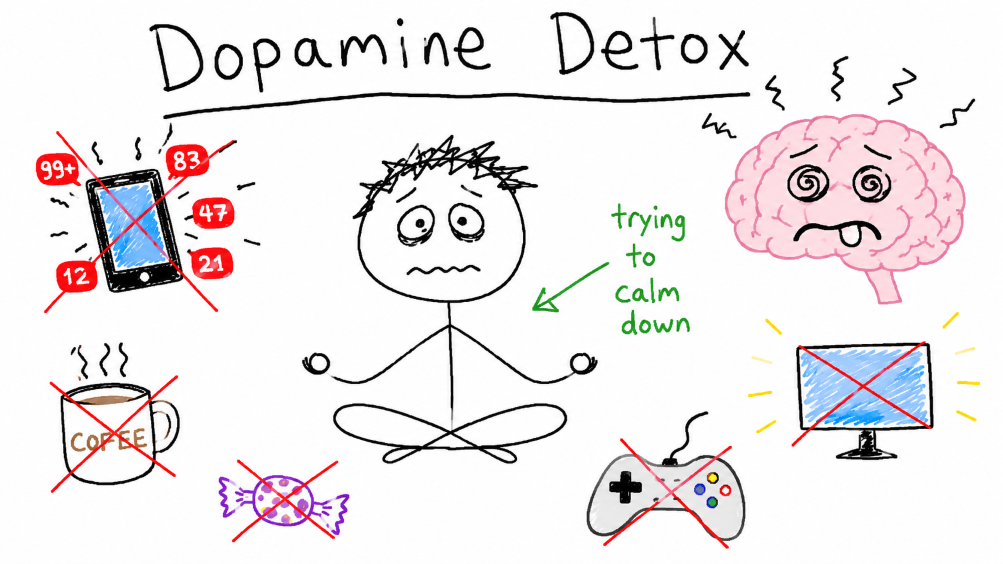
“Dopamine detox” or “dopamine fasting” usually means taking a break from highly stimulating habits such as social media, gaming, scrolling, online shopping, pornography, junk food, or constant notifications. Some online versions go further and suggest avoiding pleasure itself so the brain can “reset.”
That stronger claim is the problem. The original dopamine-fasting idea was closer to a behaviour-change strategy: pause automatic habits, reduce cues, and create space before reacting. It was not meant to be taken literally as fasting from dopamine.89
Most human studies do not test dopamine fasting directly. They test “digital detox” interventions such as social media abstinence, smartphone limits, or blocking mobile internet. These studies can tell us something about screen habits and well-being, but they cannot prove that brain dopamine has been reset.
The literal dopamine-reset claim is unsupported. There are no good human trials showing that avoiding pleasurable activities resets dopamine levels, improves dopamine receptor function, or creates a measurable “dopamine cleanse.” The strongest sources on dopamine fasting describe it as a behaviour-change idea that is often misunderstood, not as a proven neurochemical treatment.89
The behavioural claim is more plausible. Digital detox studies usually test whether reducing social media, smartphone access, or mobile internet changes mood, well-being, stress, attention, or time use. These studies show a mixed pattern: targeted restrictions may help some people, while total social media abstinence does not reliably improve mood or life satisfaction across studies.256
The most promising trial blocked mobile internet on smartphones for two weeks. Participants could still make calls, send texts, and use internet on computers. The intervention improved several outcomes, but compliance was low enough that the result should be read as promising rather than definitive.7
Overall, the likely benefits are practical rather than chemical: fewer interruptions, less mindless scrolling, less comparison, better sleep, more offline time, and more deliberate control over habits. That is still useful, but it is not the same as proving that dopamine has been reset.
- The best evidence tests behaviour change, not dopamine chemistry.12
- Meta-analyses disagree: some find small benefits; others find no significant benefit for total abstinence.356
- Most studies are short, hard to blind, and rely partly on self-reported mood or well-being.
- People differ: someone with compulsive or distressing use may respond differently from someone with balanced use.
- Marketing claims about “resetting dopamine,” “repairing receptors,” or “rebooting the brain” go beyond the evidence.
For the literal dopamine-reset claim, the evidence is consistently insufficient. The studies do not show that dopamine levels are depleted, restored, or reset by short-term abstinence.
For the behavioural claim, the evidence is mixed. Some studies show small improvements in subjective well-being, depressive symptoms, or attention. Other studies show no meaningful change in positive affect, negative affect, or life satisfaction. The differences likely come from different populations, different platforms, different intervention lengths, different outcome measures, and different levels of adherence.2567
A digital break should not replace care for addiction, ADHD, anxiety, depression, OCD, eating disorders, gambling problems, self-harm thoughts, or any behaviour that feels out of control. Those situations need proper clinical assessment and support.
The dopamine-detox claim is partly a useful behaviour idea wrapped in a misleading brain-chemistry story.
There is no reliable evidence that a dopamine detox resets dopamine. There is weak, mixed evidence that targeted limits on smartphones or social media may improve attention, mood, or well-being for some people in the short term.
The cleanest summary: reduce compulsive digital habits if they are crowding out sleep, work, relationships, or health — but do not expect a literal dopamine reset.
- Marciano L, Jindal S, Viswanath K. Digital Detox and Well-Being. Pediatrics. 2024;154(4):e2024066142. PMID 39285845 DOI State-of-the-art review
- Radtke T, Apel T, Schenkel K, Keller J, von Lindern E. Digital detox: An effective solution in the smartphone era? A systematic literature review. Mobile Media & Communication. 2022;10(2):190–215. Full text DOI Systematic review
- Ansari S, Iqbal N, Azeem A, Danyal K. Improving Well-Being Through Digital Detoxification Among Social Media Users: A Systematic Review and Meta-Analysis. Cyberpsychology, Behavior, and Social Networking. 2024. PMID 39348315 DOI Systematic review + meta-analysis
- Ramadhan RN, Rampengan DD, Yumnanisha DA, et al. Impacts of digital social media detox for mental health: A systematic review and meta-analysis. Narra J. 2024;4(2):e786. PMID 39280291 DOI Systematic review + meta-analysis
- Lemahieu L, Vander Zwalmen Y, Mennes M, Koster EHW, Vanden Abeele MMP, Poels K. The effects of social media abstinence on affective well-being and life satisfaction: a systematic review and meta-analysis. Scientific Reports. 2025;15. Full text PMID 40038410 DOI Systematic review + meta-analysis
- Burnell K, Meter DJ, Andrade FC, Slocum AN, George MJ. The effects of social media restriction: Meta-analytic evidence from randomized controlled trials. SSM – Mental Health. 2025;7:100459. Full text DOI RCT meta-analysis
- Castelo N, Kushlev K, Ward AF, Esterman M, Reiner PB. Blocking mobile internet on smartphones improves sustained attention, mental health, and subjective well-being. PNAS Nexus. 2025;4(2):pgaf017. PMID 39967678 DOI Randomized controlled trial
- Fei YY, Johnson PA, Omran NAL, Mardon A, Johnson JC. Maladaptive or misunderstood? Dopamine fasting as a potential intervention for behavioral addiction. Lifestyle Medicine. 2022;3(1):e54. Full text DOI Commentary / narrative review
- Grinspoon P. Dopamine fasting: Misunderstanding science spawns a maladaptive fad. Harvard Health Publishing. 2020. Article Medical commentary
- Nutt DJ, Lingford-Hughes A, Erritzoe D, Stokes PRA. The dopamine theory of addiction: 40 years of highs and lows. Nature Reviews Neuroscience. 2015;16:305–312. PMID 25873042 DOI Neuroscience review
- Kim SH, Baik SH, Park CS, Kim SJ, Choi SW, Kim SE. Reduced striatal dopamine D2 receptors in people with Internet addiction. NeuroReport. 2011;22(8):407–411. PMID 21499141 DOI Case-control neuroimaging
- Setia S, Gilbert F, Tichy ML, Redpath J, Shahzad N, Marraccini ME. Digital Detox Strategies and Mental Health: A Comprehensive Scoping Review of Why, Where, and How. Cureus. 2025;17(1):e78250. PMID 40026988 DOI Scoping review