High-dose omega-3 and memory: what a two-year trial found
NOT PROVEN
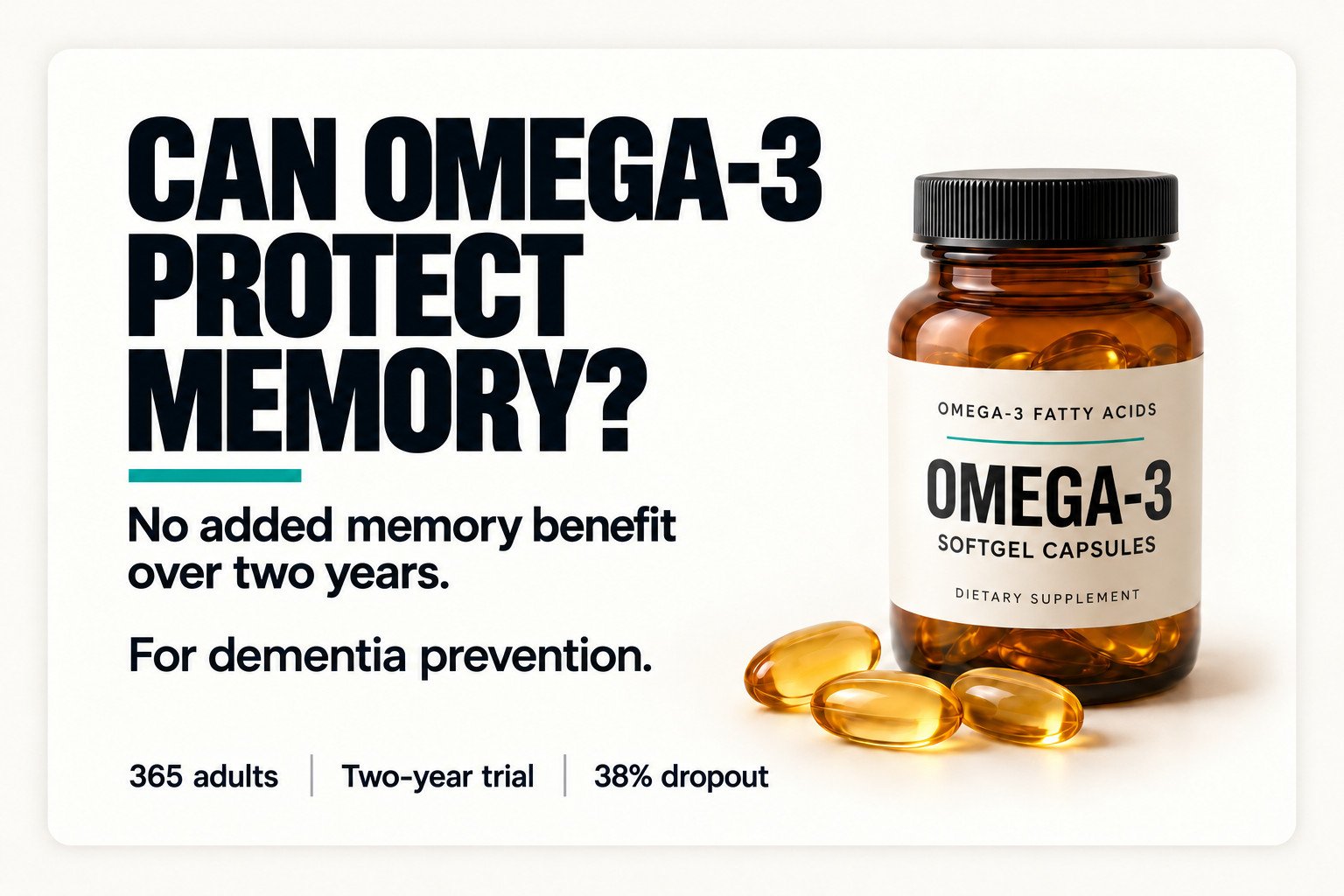
DHA [docosahexaenoic acid], an omega-3 fatty acid, changed a marker in the fluid around the brain. In this two-year trial, it offered no measurable thinking or memory advantage over placebo capsules, a comparison treatment without added DHA. [1]
Evidence scope: one randomised trial in adults without dementia.
The claim being checked
“Taking high-dose DHA supplements protects memory and helps prevent dementia.”
The PreventE4 trial tested whether high-dose DHA changed a brain-fluid marker and whether participants gained a thinking or brain-structure advantage. Its results leave dementia prevention unproven. [1]
Evidence at a glance
These figures describe the supplied trial. [1]
What did the researchers test?
Researchers at the University of Southern California randomly assigned participants to DHA or matching placebo capsules. Participants and the researchers assessing outcomes did not know who received which treatment, helping reduce bias. [1]
Participants had neither dementia nor mild cognitive impairment, measurable thinking or memory problems short of dementia, at enrolment. Nearly half carried a genetic variant associated with higher Alzheimer’s disease risk.
The main outcome was a six-month change in the ratio of DHA to arachidonic acid, another fatty acid, in cerebrospinal fluid, the fluid surrounding the brain and spinal cord. Brain scans and thinking tests helped assess whether the biological change translated into a measurable benefit. [1]
What the evidence says
Supported The supplement changed the brain-fluid marker
Among 167 participants with cerebrospinal-fluid data, DHA clearly increased the ratio of DHA to arachidonic acid at six months. The effect did not clearly differ according to the genetic risk variant studied. [1]
Researchers call this “target engagement”: evidence that an intervention affected its intended biological target. Here, the fluid measurement supported increased DHA availability within the central nervous system, which includes the brain and spinal cord.
Not supported A thinking or memory benefit over two years
Both groups’ average thinking-test scores improved by similar amounts. The reported difference in overall score change was 0.09 points, with a 95% confidence interval, a measure of statistical uncertainty, from -2.21 to 2.39 points. [1]
The trial detected no treatment advantage. The uncertainty range included scores favouring either group, so this result cannot establish that every possible benefit is zero.
Not supported A measurable brain-structure benefit
Researchers found no clear treatment advantage in the reported measures of brain structure. These included the hippocampus, a region important for memory. [1]
A change in the surrounding fluid therefore cannot be assumed to mean that brain tissue was protected.
NOT PROVEN Whether DHA prevents dementia over the longer term
The primary outcome concerned a biochemical marker. Thinking tests were exploratory outcomes, and the trial did not establish a reduction in dementia diagnoses. [1]
Two years of follow-up in this selected population cannot settle whether supplementation changes dementia risk over a much longer period.
The important distinction: A favourable change in a biological marker needs to translate into an outcome that matters to people. In this trial, the brain-fluid change came without a demonstrated thinking or memory benefit.
Why the result needs careful interpretation
Dropout was substantial. Thirty-eight per cent of participants withdrew, with the authors describing major pandemic disruption. Those who withdrew differed from completers in education, starting thinking-test scores and other characteristics, creating uncertainty about the final estimates. [1]
There was little decline to prevent. Participants generally maintained their thinking performance and brain structure. Detecting whether a treatment slows decline becomes harder when the comparison group barely declines.
The main question concerned delivery. The trial was primarily designed around a brain-fluid marker. It was not a definitive test of long-term dementia prevention. [1]
These limitations leave room for uncertainty. They do not turn the absence of a demonstrated clinical benefit into evidence that a benefit exists.
Funding and conflicts
The study received support from the National Institute on Aging, the Alzheimer’s Drug Discovery Foundation and philanthropic sources. The paper states that the funding agencies had no role in the study’s design, analysis, interpretation or publication decision. [1]
One author disclosed pharmaceutical-industry grants, contracts and consulting relationships outside the submitted work. The other authors declared no competing interests.
Safety in this trial
Reported health problems, recorded as adverse events, occurred in approximately 40% of participants in each group. Researchers attributed no serious adverse events to the treatment. [1]
These findings describe tolerability within the trial. They provide limited information about uncommon harms or longer use.
The key study
On mobile: swipe sideways to view all columns.
| Source | What it found | Main limitations |
|---|---|---|
| Yassine and colleagues, 2026 Randomised, double-blind, placebo-controlled trial. 365 randomised; 225 completed. Read the study [1] |
DHA changed a cerebrospinal-fluid marker at six months. No measurable thinking-test or brain-structure advantage over 24 months. | 38% dropout; little overall decline; one centre; thinking outcomes exploratory. Both groups also received vitamin B-complex. Pharmaceutical relationships disclosed outside the work. |
What this means for you
This trial gives no demonstrated thinking or memory benefit to support taking high-dose DHA for that purpose. It shows why a supplement’s effect on a biological measurement needs to be checked against outcomes that matter to people.
The findings concern this supplement regimen and population. Questions about eating fish, treating a deficiency or using omega-3 products for other indications require their own evidence.
Frequently asked questions
Did high-dose DHA improve memory in this trial?
The trial found no measurable advantage in overall thinking-test performance over two years. Average scores improved by similar amounts in the DHA and placebo groups. [1]
Did the supplement reach the brain?
It increased a DHA-related measurement in the fluid surrounding the brain and spinal cord. Researchers used this as evidence of delivery, but that measurement does not establish protection of brain tissue or better memory. [1]
How much DHA did participants take?
The active group received 2 grams of DHA daily for 24 months. Both groups also received vitamin B-complex. This describes the research intervention and is not a dosage recommendation. [1]
Does this settle whether DHA prevents dementia?
No. The main outcome concerned a biochemical marker, and thinking outcomes were exploratory. The study did not establish a reduction in dementia diagnoses. [1]
Was high-dose DHA safe?
Adverse-event rates were similar between groups, and researchers attributed no serious events to treatment. The trial cannot rule out uncommon harms or establish safety for every person or duration of use. [1]
References
- Yassine HN and colleagues. Central nervous system target engagement of high-dose DHA supplementation in older adults at risk for dementia: a randomised, double-blind, placebo-controlled trial. eBioMedicine. 2026;129:106316. Published 18 June 2026. Randomised clinical trial. Read the full study.
Study discussed: published 18 June 2026.
Disclaimer: This article is for general educational information only and is not medical advice. It does not diagnose, treat, or replace care from a qualified health professional. Always speak with a qualified health professional about personal health questions, medicines, pregnancy, medical conditions, or before changing treatment.