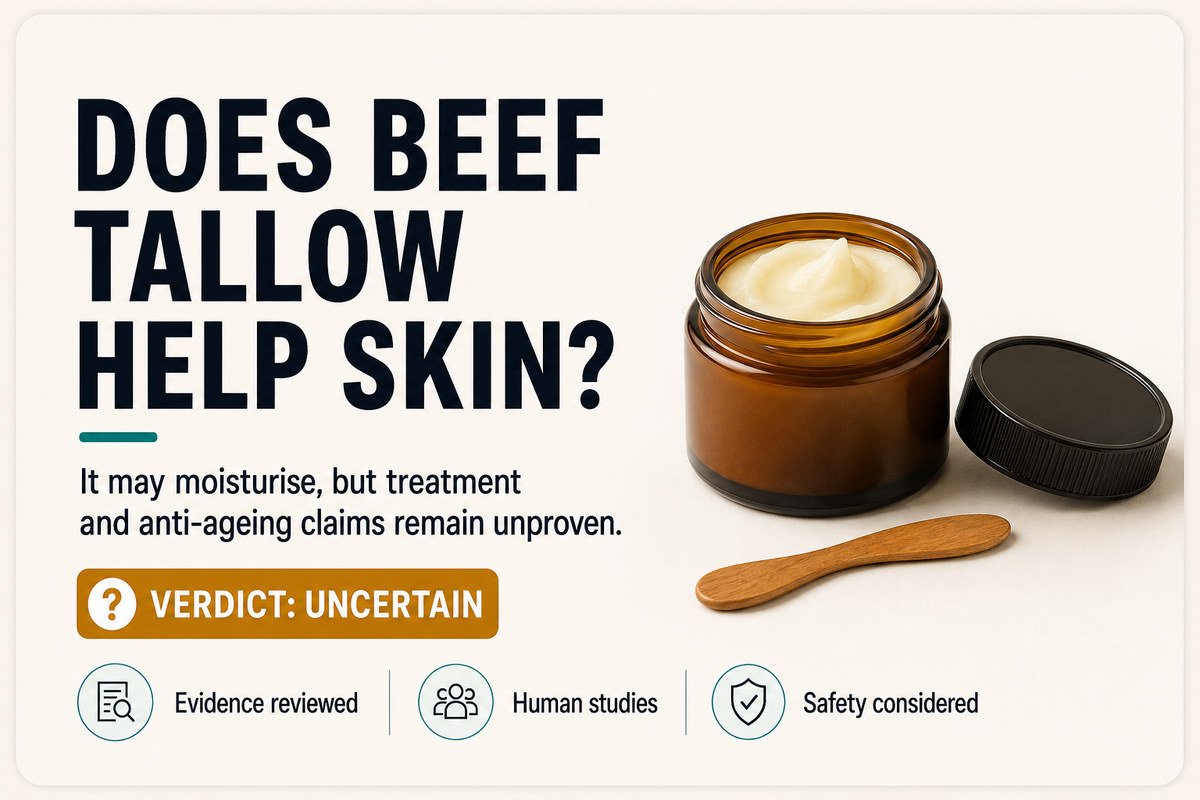
Beef Tallow for Skin: Moisturiser or Social Media Hype?
🔶 WEH verdict: Uncertain
Beef tallow may act as a basic greasy moisturiser, but claims that it is skin-identical, superior to standard moisturisers, or able to treat acne, eczema, psoriasis, or ageing skin run ahead of the human evidence.
Evidence certainty: Very low (●○○○)
The claim
Beef tallow is a natural, skin-compatible moisturiser that repairs the skin barrier and can improve acne, eczema, psoriasis, or signs of ageing.
In brief
Tallow is a rendered animal fat. Like other oily products, it can coat the skin and reduce the feeling of dryness for some people. That is a reasonable moisturising mechanism, but it is not the same as showing that beef tallow improves a diagnosed skin condition or works better than a well-formulated moisturiser.
The published evidence is surprisingly thin. A 2024 scoping review found 19 relevant publications, but most did not directly test plain beef tallow on human skin. The authors concluded that major gaps remain, especially in human research.[1]
Evidence at a glance
Why has beef tallow become so popular?
Tallow fits several current skincare stories at once: natural ingredients, traditional practices, short ingredient lists, and suspicion of highly formulated products. Social media often adds stronger claims, including that tallow matches human skin oils or treats inflammatory skin disease.
A study of 200 YouTube, Instagram, and TikTok posts collected in December 2024 found that 82% recommended tallow. Only 9 posts cited scientific evidence, while the researchers identified commercial or financial bias in many posts.[3] This tells us why the claim spreads. It does not tell us whether the product works.
What the best evidence says
Plausible, not proven Tallow can act as an occlusive moisturiser
An occlusive moisturiser forms an oily layer that slows water loss from the skin. Tallow can plausibly do this, which may make dry skin feel softer for a time.
However, this basic physical effect has not been established in strong direct trials of plain beef tallow. It also does not show that tallow repairs the skin barrier better than petrolatum, ceramide creams, or other established moisturisers.[1]
Uncertain The human evidence is indirect
The most relevant human study enrolled 78 people and tested emulsions made with modified mutton tallow and walnut oil. Researchers assessed features such as skin moisture, product stability, and user experience.[2]
It was not a trial of plain beef tallow, and it did not establish treatment for acne, eczema, psoriasis, or skin ageing. Its findings cannot be cleanly transferred to the tallow products promoted online.
Not supported Tallow is not established as skin-identical
Tallow and human skin oils share some fatty acids, but sharing ingredients is not the same as being identical. Human sebum, the oily material produced by sebaceous glands, contains a distinctive mixture that includes triglycerides, wax esters, free fatty acids, squalene, cholesterol, and cholesterol esters.[4]
Beef tallow does not reproduce that full composition. The phrase “skin-identical” is therefore stronger than the evidence supports.
Uncertain Its fatty acids do not guarantee barrier repair
Fatty-acid composition is often used as a shortcut to claim that tallow nourishes or repairs skin. Skin effects depend on the full formulation, concentration, oxidation, other ingredients, and the condition of the user’s skin.
In a controlled human application study, topical oleic acid increased transepidermal water loss, meaning water escaping through the skin, and produced irritation.[5] This does not prove that tallow harms skin. It does show why the presence of a familiar fatty acid cannot, by itself, prove barrier repair.
Not supported Treatment claims for acne, eczema, and psoriasis
The available research does not establish beef tallow as a treatment for acne, eczema, or psoriasis. The 2024 review found too little direct human evidence to support these disease claims.[1]
A heavy oily product may suit some dry skin, but whether beef tallow clogs pores or worsens acne has not been established in clinical trials. Individual experience is not proof of treatment.
Not supported Tallow as a natural alternative to retinoids
There is no good clinical evidence that beef tallow reproduces the biological effects of topical retinoids or delivers comparable improvements in fine lines, pigmentation, or acne. Moisturised skin can look temporarily smoother, but that is not the same as changing the processes targeted by a retinoid.
What this evidence does not prove
- It does not prove that plain beef tallow treats a diagnosed skin condition.
- It does not show that tallow is better than standard fragrance-free moisturisers.
- It does not show that every tallow product behaves the same way. Rendering, storage, added fragrance, oils, and preservatives can change a product.
- It does not establish long-term safety on acne-prone, inflamed, or damaged skin.
- It does not support calling tallow “skin-identical” or a substitute for retinoids.
Why WEH rates it uncertain
The overall certainty is very low. The main review mapped a small and highly mixed literature rather than pooling high-quality clinical trials. Most included research was indirect, and the review did not perform a formal risk-of-bias assessment.[1]
The limited human study did not test plain beef tallow or measure whether it treated the conditions promoted on social media.[2] Better trials need to compare standardised tallow formulations with established moisturisers and measure clinically meaningful skin outcomes.
Safety and practical use
If you want to try it: choose a clearly labelled product, avoid rancid or poorly stored products, and test a small area first. Stop using it if you develop persistent redness, itching, burning, or worsening breakouts.
Do not use a cosmetic tallow product as a replacement for prescribed treatment for eczema, psoriasis, acne, infection, or another skin condition. Queensland Health also cautions that tallow may feel heavy, may not suit every skin type, and varies between products.[6]
In Australia, moisturising and cosmetic claims are regulated differently from claims to treat disease or alter a body process. Acne, eczema, and psoriasis treatment claims may move a product into the therapeutic-goods framework, depending on its claims and presentation.[7]
Key studies and sources
On mobile: swipe sideways to view all columns.
| Source | What it found | Main limitations |
|---|---|---|
| Russell et al., 2024 Scoping review, 19 publications |
Mapped possible skin-related effects of tallow and rendered animal fats; concluded that major research gaps remain. | Mostly indirect and non-human evidence; varied products and outcomes; only two databases searched; no formal risk-of-bias assessment. |
| Kowalska et al., 2017 Human product study, 78 participants |
A modified mutton-tallow and walnut-oil emulsion showed acceptable product and skin-moisture characteristics. | Not beef tallow; not plain tallow; combined formulation; no acne, eczema, psoriasis, or anti-ageing treatment outcome. |
| Almatroud et al., 2025 Cross-sectional social-media analysis, 200 posts |
Promotion was overwhelmingly positive, while only 9 posts cited scientific evidence. | Measures online messaging, not product efficacy or safety; posts were collected during one period. |
| Harrison and Spada, 2024 Review of human skin lipids |
Describes human sebum as a complex mixture including wax esters, squalene, cholesterol compounds, and fatty materials. | Not a tallow treatment trial; useful for testing the “skin-identical” rationale only. |
| Tanojo et al., 1998 Controlled human skin application study |
Oleic acid increased water loss through the skin and caused irritation under the study conditions. | Tested an isolated fatty acid, not beef tallow; cannot determine the effect of a complete tallow product. |
Bottom line
Beef tallow is best understood as an inadequately studied oily moisturiser, not a proven skin treatment. It may soften dry skin for some people, but there is no solid evidence that it is uniquely compatible with human skin, superior to standard moisturisers, or effective for acne, eczema, psoriasis, or skin ageing.
If it works comfortably as a simple moisturiser for you, that is a personal product preference. It should not be mistaken for proof of the broader claims attached to it online.
Frequently asked questions
Is beef tallow a good moisturiser?
It may reduce the feeling of dryness by leaving an oily layer on the skin. Direct comparative trials are lacking, so we do not know whether it works better than ordinary fragrance-free moisturisers.[1]
Does beef tallow help eczema or psoriasis?
There is not enough direct human evidence to recommend beef tallow as a treatment for either condition. A moisturiser may help dryness, but it does not replace treatment aimed at inflammation or disease control.
Is beef tallow identical to human skin oil?
No. The two share some fatty acids, but human sebum contains a distinctive mixture of wax esters, squalene, cholesterol compounds, and other lipids. Similarity is not identity.[4]
Is tallow a natural alternative to retinol?
No reliable clinical evidence shows that tallow delivers the effects of topical retinoids. It may make dry skin look smoother temporarily, but that does not establish comparable effects on acne, pigmentation, or skin ageing.
Is natural beef tallow safer than a formulated moisturiser?
“Natural” does not guarantee safer or better tolerated. Products vary in rendering, storage, and added ingredients, so naturalness alone does not answer whether a product will suit your skin.[6]
References
- Russell et al. Tallow, Rendered Animal Fat, and Its Biocompatibility With Skin: A Scoping Review. Cureus. 2024. Full text.
- Kowalska et al. Human study of emulsions containing modified mutton tallow and walnut oil. 2017. PubMed.
- Almatroud et al. Social-media analysis of beef tallow for skincare. Journal of Cosmetic Dermatology. 2025. Journal page.
- Harrison and Spada. Review of human skin surface lipids and sebum. 2024. PubMed.
- Tanojo et al. Human skin-barrier effects of topically applied fatty acids. 1998. PubMed.
- Queensland Health. Dermatologist has beef with beef tallow skincare: why this trend might not be so moo-vellous. 30 July 2025. Queensland Health.
- Therapeutic Goods Administration. Understanding complementary medicine interface issues. Regulator guidance.
Last reviewed: 4 September 2026
Disclaimer: This article is for general educational information only and is not medical advice. It does not diagnose, treat, or replace care from a qualified health professional. Always speak with a qualified health professional about personal health questions, medicines, pregnancy, medical conditions, or before changing treatment.