Are Melatonin Gummies Safe for Children?
Evidence review
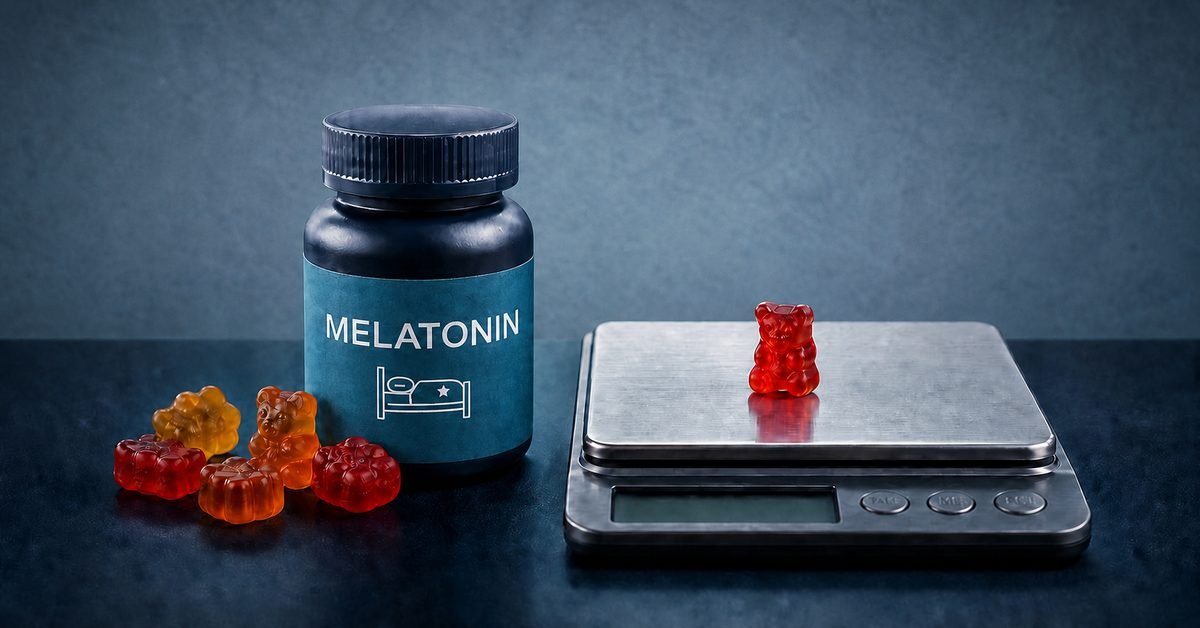
A melatonin gummy looks like a sweet, but it delivers a biologically active hormone. The safety question has three separate parts: what melatonin does in a child’s body, whether the product contains the labelled dose, and whether its candy-like form increases accidental ingestion.
Short-term trials did not detect more serious adverse events in selected children, but non-serious effects were more frequent. Long-term developmental safety remains uncertain. Laboratory testing also shows that some unregulated gummies contain substantially more or less melatonin than their labels state.
Evidence at a glance
Prescribed melatonin and an online gummy are not the same
Melatonin regulation varies globally. In some countries it is treated as a prescription medicine, while in others it can be sold as a dietary supplement. This distinction matters because medicine regulators assess manufacturing standards and approved indications. An unverified product bought online may not have the same dose reliability.
Form also matters. A gummy can be easier to administer, but a young child may mistake it for ordinary confectionery. That changes the risk of unsupervised ingestion.
What the best evidence says
UncertainSerious short-term harm was not detected
A systematic review included 22 randomised controlled trials and 1,350 children or adolescents. Across 11 trials with 855 participants, serious adverse events were not detectably increased: relative risk 1.03, 95% confidence interval 0.58 to 1.86.[1]
This is not the same as proving that no serious risk exists. The interval remains compatible with both lower and higher risk, and the trials were not large enough to detect very uncommon events.
SupportedNon-serious adverse effects are more frequent
Across 17 trials with 1,017 participants, non-serious adverse events were more frequent with melatonin: relative risk 1.56, 95% confidence interval 1.01 to 2.43. The estimated absolute increase was about six percentage points.[1]
Reported effects included headache, nausea, fatigue or drowsiness, dizziness, vomiting, gastrointestinal symptoms and changes in mood or cognition.
UncertainLong-term development has barely been studied
Only four observational studies, totalling 105 children, assessed pubertal development. Results were inconsistent and the certainty was very low. The review found no useful evidence on bone density or fractures.[1]
This is a major evidence gap, not evidence that long-term developmental harm occurs.
SupportedSome gummies contain unreliable doses
A JAMA laboratory study tested 25 melatonin gummy products sold in the United States. Twenty-two were inaccurately labelled. Detectable melatonin ranged from 74% to 347% of the declared amount. One product contained no melatonin but contained 31.3 mg of cannabidiol (CBD).[2]
In separate testing, Australia’s Therapeutic Goods Administration analysed 18 imported products intercepted at the border. Twelve differed significantly from their labels, five differed by more than 50%, and one product labelled as containing 10 mg contained no melatonin.[3]
These selected samples do not prove that every gummy or every country’s products are inaccurate. They do demonstrate that label reliability cannot be assumed for unregulated or unverified products.
SupportedCandy-like products increase accidental-ingestion risk
US surveillance estimated 10,930 emergency-department visits for unsupervised melatonin ingestion among children aged five or younger from 2019 to 2022. Gummies were involved in 47.3% of cases. Most children, 93.5%, were not hospitalised.[4]
These data describe accidental ingestion, not correctly administered treatment. They support secure storage rather than claims that a normal dose commonly causes an emergency.
What international experts recommend
The International Pediatric Sleep Association recommends a thorough sleep assessment, behavioural approaches as first-line treatment, medical supervision, secure storage and avoiding unverified online products. Its 2025 consensus says melatonin should generally not be given to typically developing children under two and that treatment should be kept as short as possible because long-term evidence is limited.[5]
Regulatory permissions differ by country. For example, Australia’s TGA limits approved paediatric use to prescription treatment in specific conditions, and states that broader paediatric safety and efficacy have not been evaluated.[6] This is a jurisdiction-specific example, not a global rule.
Melatonin gummies should be stored as medicines, out of sight and reach of children, and never mixed with ordinary sweets or fruit snacks. Suspected excessive or accidental ingestion requires advice from the relevant local poison-information or emergency service.
Key studies
On mobile: swipe sideways to view all columns.
| Source | What it found | Main limitations |
|---|---|---|
| Paediatric safety review, 2023 22 RCTs, N=1,350 | No detected increase in serious events; non-serious events increased, RR 1.56. | Mixed populations and formulations; short follow-up; only 105 children in long-term puberty studies. |
| US gummy analysis, 2023 25 products | 22 inaccurately labelled; melatonin ranged from 74% to 347% of label. | Small US sample; one purchase period; laboratory content, not clinical outcomes. |
| TGA imported-product testing, 2025 18 products | 12 differed significantly from labels; five differed by more than 50%. | Selected intercepted imports; not representative of all countries or regulated medicines. |
| CDC emergency surveillance, 2024 US children aged 5 or younger | Estimated 10,930 ED visits after unsupervised ingestion; gummies in 47.3%. | Weighted surveillance estimates; accidental ingestion, not prescribed use. |
Melatonin gummies should not be treated as harmless bedtime sweets. Short-term prescribed use may be reasonable for selected children under professional supervision, but non-serious adverse effects occur, long-term safety is uncertain, some unregulated products contain unreliable doses, and candy-like formulations increase accidental-ingestion risk.
Frequently asked questions
Are melatonin gummies safe for children?
A blanket safety claim is not supported. Short-term prescribed use has not shown more serious adverse events in selected children, but non-serious effects occur, long-term safety is uncertain and unregulated gummies can contain unreliable doses.
What side effects can melatonin cause in children?
Reported effects include headache, nausea, fatigue or drowsiness, dizziness, vomiting and changes in mood or cognition.
Do melatonin gummies contain the dose on the label?
Not always. Laboratory studies of selected US and imported products found large differences between labelled and measured melatonin amounts.
Does melatonin affect puberty?
The evidence is too limited for a confident conclusion. Only four small observational studies with 105 children were available in a major safety review.
Why are gummies an accidental-ingestion risk?
Their sweet taste and candy-like appearance can encourage young children to eat multiple gummies. Surveillance data show thousands of emergency visits after unsupervised ingestion.
Should melatonin be the first response to a child’s sleep problem?
International paediatric sleep experts recommend a clinical sleep assessment and behavioural approaches before, and alongside, any medically supervised melatonin use.
References
- The short-term and long-term adverse effects of melatonin treatment in children and adolescents: A systematic review and GRADE assessment. 2023.
- Quantity of Melatonin and CBD in Melatonin Gummies Sold in the US. JAMA. 2023.
- Therapeutic Goods Administration. Imported melatonin samples: Summary report. 2025.
- Emergency Department Visits for Unsupervised Pediatric Melatonin Ingestion, United States, 2019 to 2022. CDC MMWR. 2024.
- International Pediatric Sleep Association. Expert consensus recommendations for melatonin use in typically developing children. 2025.
- Therapeutic Goods Administration. Regulation of melatonin products in Australia. 2025.