
Doctors Ask This Too: Which Probiotics Are Proven to Help?
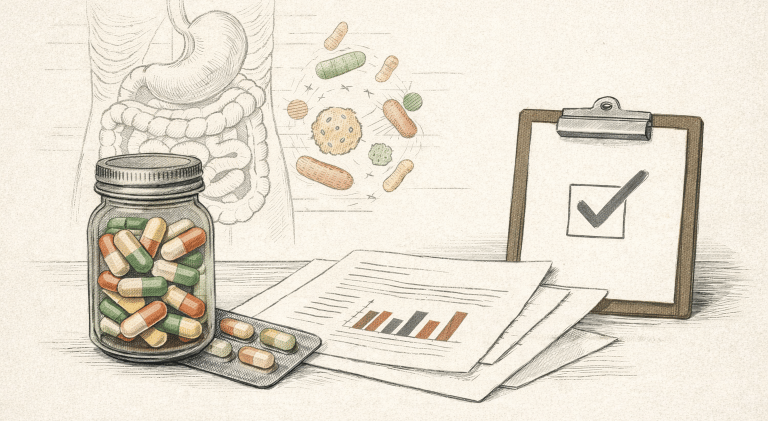
We reviewed the largest, highest-quality studies on probiotics across five key conditions. Here’s what we found — clear, concise, and backed by hard numbers.
IBS (Irritable Bowel Syndrome)
Verdict: ✅ Effective for symptom relief and quality of life, especially short-term use
Why: Three major meta-analyses (e.g., Chen 2023, Niu 2020, ~13,000 patients) show consistent benefits on global IBS symptoms and abdominal pain. A well-powered RCT (Whorwell 2006, N=362) confirmed Bifidobacterium infantis 35624 improved symptoms by ~20% over placebo.
Strains with evidence:
- Bifidobacterium infantis 35624 (Whorwell 2006)
- Lactobacillus plantarum 299v (cited in meta-analyses)
- Multi-strain mixes (several used in meta-analyses like Niu 2020)
--------------------------------------
AAD (Antibiotic-Associated Diarrhea)
Verdict: ✅ Effective, especially in children and hospitalized adults
Why: Meta-analyses covering >15,000 participants (Hempel 2012) found probiotics cut AAD risk by ~42% (RR ~0.58, NNT ~10–13). Inpatients in Hickson 2007 saw a 2–3× reduction in AAD and C. difficile diarrhea.
Strains with evidence:
- Lactobacillus rhamnosus GG (multiple pediatric trials)
- Saccharomyces boulardii CNCM I-745 (widely supported, especially in adults)
- Lactobacillus acidophilus, Bifidobacterium bifidum (part of multispecies combo in Hickson 2007)
----------------------------------------
BV (Bacterial Vaginosis)
Verdict: ✅ Effective for short-term cure and reducing recurrence
Why: Short-term cure rates doubled with probiotics (RR 2.57, Wang 2019), and recurrence dropped 45% (RR 0.55, Chieng 2022). A NEJM trial (Cohen 2020, N=228) showed vaginal Lactobacillus crispatus CTV-05 cut BV recurrence significantly.
Strains with evidence:
- Lactobacillus crispatus CTV-05 (Cohen 2020)
- Lactobacillus rhamnosus, L. reuteri, L. acidophilus (in various oral/vaginal mixes from Wang 2019)
-------------------------------------------
Acute Diarrhea (especially pediatric AGE)
Verdict: ⚠️ Mixed: older reviews positive, newer trials neutral
Why: Earlier studies (Allen 2010, N=8,000) showed probiotics shortened diarrhea by ~1 day. But recent large trials (Schnadower & Freedman 2018, N~1,800) and an updated review which was superseded by a major study published in December 2020 (Collinson et al., N=12,127, which still included Allen SJ as a co-author). The 2020 update included more stringent evidence requirements and actually dialed back some of the 2010 conclusions: probiotics might make little to no difference in how long diarrhea lasts based on the newest high-quality trials.
Strains with evidence:
- Mixed: Lactobacillus rhamnosus GG (Schnadower 2018 – no effect)
- Lactobacillus helveticus R0052 + L. rhamnosus R0011 (Freedman 2018 – no effect)
- Older meta-analyses supported S. boulardii and L. reuteri, but newer trials challenge this
-------------------------------------------------
H. pylori (Adjunct to Eradication Therapy)
Verdict: ✅ Effective adjunct that improves success rates and reduces side effects
Why: A comprehensive meta-analysis (Tanashat 2025, N=13,680) showed higher eradication (OR ~1.6) and ~50% fewer side effects (e.g., diarrhea, taste disturbance). Earlier studies confirmed the effect, especially for Bifidobacterium and Lactobacillus strains.
Strains with evidence:
- Lactobacillus reuteri DSM 17938
- Lactobacillus rhamnosus, L. casei, Bifidobacterium bifidum, B. breve (frequent in combo products)
- S. boulardii also shown to reduce AAD in H. pylori therapy
Bottom Line?
Probiotics aren’t miracle cures — but for several conditions, the evidence is strong. Choose strain-specific, high-quality products, and match them to the condition. For IBS, BV, AAD, and H. pylori support, probiotics are worth considering.
Mentioned studies