Claim: “Smart rings accurately track sleep, heart signals, steps, and calories — and can improve your health.”
DEVICES
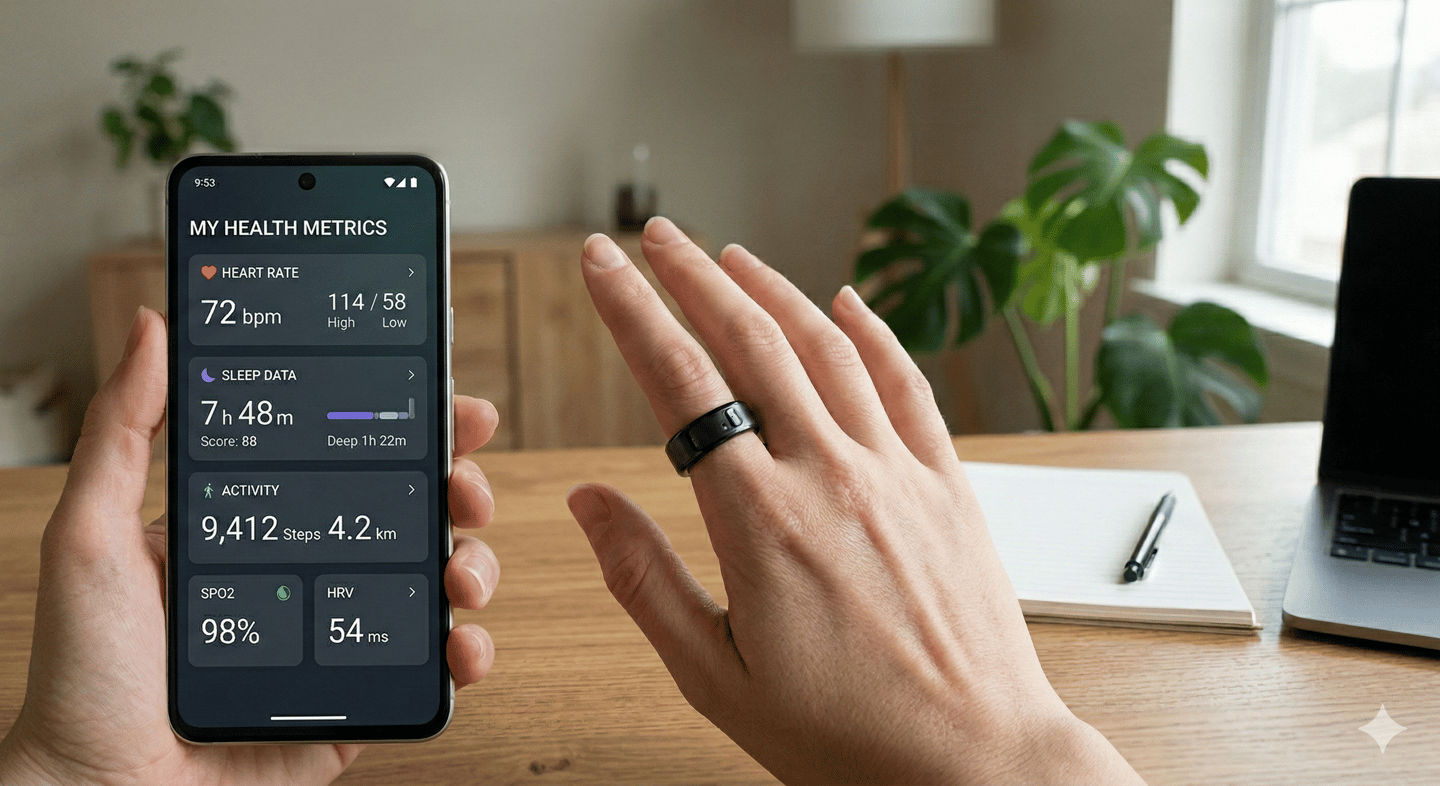
• Sleep totals: Fairly good, but sleep stages and wake periods are less reliable
• Overnight heart rate / HRV: Looks strong in validation studies
• Steps / calories: Useful for trends, not exact numbers
The Marketing Claims vs the Evidence
Claim 1: Smart rings accurately track sleep
Evidence: Reasonably good for basic sleep totals, but weaker for detailed sleep stages and brief wake periods
Claim 2: Smart rings accurately track heart rate and HRV
Evidence: Strong overnight validation against ECG in one human study
Claim 3: Smart rings give accurate step counts and calorie burn
Evidence: Good for broad trends, but not exact, especially as exercise intensity increases
Claim 4: Smart rings improve sleep, recovery, or overall health
Evidence: No direct trial evidence in the attached study set
When you look past the marketing, smart rings seem best at tracking total sleep time, overnight heart rate, and heart-rate variability (HRV). They look less reliable for sleep stages, catching short awake periods, and exact calories or steps. Just as important, the below studies do not show that wearing a smart ring improves health outcomes. They mainly test how closely the ring matches reference tools like sleep-lab testing or ECG.
How we chose the evidence (to avoid cherry-picking)
This post is based on the five attached human validation studies on smart rings. That is useful evidence, but it is not the same as a full systematic review, and it is not a set of treatment trials. Most of the direct evidence here is on Oura®, usually in healthy people, so this is best read as a careful evidence snapshot rather than a final answer for all rings on the market.
If you came across a bigger study (not sponsored by the ring makers and where conventional reference methods were used), please let us know.
Evidence snapshot (what this post is based on)
Best evidence source here: Five human validation studies comparing smart-ring data against reference methods like PSG (the full sleep-lab test), ECG (a medical heart tracing), actigraphy (a research sleep tracker), and indirect calorimetry (a lab method used to estimate calories burned).
Key strength: These are direct head-to-head comparisons in real people.
Key limitation: These are accuracy studies, not trials showing that smart rings improve sleep, fitness, or long-term health.
Other limitation: The evidence base is somewhat narrow: mostly one brand and mostly healthy participants.
Key studies
Svensson et al., 2024 — multi-night sleep validation vs PSG. PMID: 38382312
de Zambotti et al., 2019 — sleep-lab validation vs PSG. PMID: 28323455
Mehrabadi et al., 2020 — home sleep tracking vs actigraphy. PMID: 33038869
Kinnunen et al., 2020 — overnight heart rate and HRV validation vs ECG. PMID: 32217820
Kristiansson et al., 2023 — steps and energy expenditure validation vs indirect calorimetry plus free-living tracking. PMID: 36829120
What the studies found
1) Sleep tracking
What most people want is simple: “Does the ring tell me how long I slept, and how well I slept?”
In Svensson et al. 2024, Oura Gen3 was compared with PSG in 96 participants over multiple nights. It matched PSG fairly well for time in bed, total sleep time, time to fall asleep, time awake during the night, light sleep, and deep sleep. Sleep/wake sensitivity was 94.4%–94.5%, specificity was 73.0%–74.6%, and overall accuracy was 91.7%–91.8%
In de Zambotti et al. 2019, the ring did well for basic sleep totals in 41 healthy adolescents and young adults, but it underestimated deep sleep and overestimated REM sleep. It had 96% sensitivity for detecting sleep, but only 48% specificity for detecting wake, meaning it was much better at noticing sleep than brief awake periods
In Mehrabadi et al. 2020, home tracking over 7 days in 45 healthy adults showed good correlation for total sleep time (r = 0.86) but more modest correlation for WASO (r = 0.41) and sleep efficiency (r = 0.47) (WASO is how long you were awake during the night after first falling asleep.
Sleep efficiency is how much of your time in bed was actually spent asleep)
Bottom line: Smart rings look fairly good for basic sleep totals, but less reliable for sleep stages and for catching short awake periods during the night.
2) Overnight heart rate and HRV
This is where the evidence looks strongest in the attached set.
In Kinnunen et al. 2020, nightly heart rate and HRV from the ring were compared with ECG in 49 adults aged 15–72. Agreement was very high: r² = 0.996 for heart rate and r² = 0.980 for HRV. Average bias was small: -0.63 beats/minute for heart rate and -1.2 milliseconds for HRV
Bottom line: Overnight heart rate and HRV look like the most credible smart-ring measures in this set of studies. But this was mainly in healthy people, and it was focused on night-time readings.
3) Steps and energy expenditure
This is an area where marketing often sounds more precise than the data.
In Kristiansson et al. 2023, the ring was tested against indirect calorimetry and during 14 days of free-living monitoring in 32 participants. Correlations were strong in the lab (r = 0.93) and solid in daily life (r ≥ 0.76), but the ring underestimated energy use more as exercise intensity increased and showed systematic over- or under-estimation for steps and energy measures (PMID: 36829120).
Bottom line: Smart rings may be useful for broad activity trends, but they are not great for exact personal calorie counts or perfectly precise step data.
4) Do smart rings improve health?
This is the biggest gap.
The attached evidence set contains validation studies, not trials testing whether smart rings improve sleep quality, fitness, recovery, or other health outcomes.
So even if a ring tracks some measures reasonably well, that does not automatically mean it improves health.
Bottom line: Tracking accuracy is not the same as proven health benefit.
Study spotlight (WEH): Svensson et al., 2024 — multi-night sleep validation
Study type: Human validation study against PSG, the full overnight sleep-lab test. PMID: 38382312
What they did: Compared Oura Gen3 with PSG across multiple nights in 96 participants.
Key result: The ring showed fairly good agreement for several basic sleep measures, with sleep/wake sensitivity around 94.4%–94.5% and specificity around 73.0%–74.6%.
Strengths: Larger sample than many earlier studies, and it used multiple nights rather than a single-night snapshot.
Limitations: Mostly healthy adults and only one brand, so the findings may not apply equally to other rings or to people with sleep disorders.
What smart rings seem best at
Total sleep time
Overnight heart rate
Night-time HRV
Following broad patterns over time
What smart rings seem weaker at
Detailed sleep-stage breakdowns
Catching brief awake periods
Exact calorie burn
Highly precise step counts
What wasn’t measured (but is often implied)
Across these five studies, researchers did not show:
that smart rings improve sleep
that they improve fitness or recovery
that they improve long-term health outcomes
that results apply broadly across many brands or many clinical populations
Practical takeaways
If you use a smart ring, the safest way to think about it is as a trend tracker, not a medical-grade truth machine.
Put more weight on overall sleep time, overnight heart rate, and HRV
Be more cautious with sleep stages, wake detection, and calorie burn
Look at patterns over weeks, not one unusual night
If you have symptoms or a medical concern, don’t let a wearable replace proper medical assessment
Based on the attached human validation studies, smart rings — especially Oura in these studies — look reasonably credible for basic sleep totals and overnight heart signals, but less reliable for detailed sleep stages, wake detection, and exact calorie or step counts.
Last reviewed: March 2026