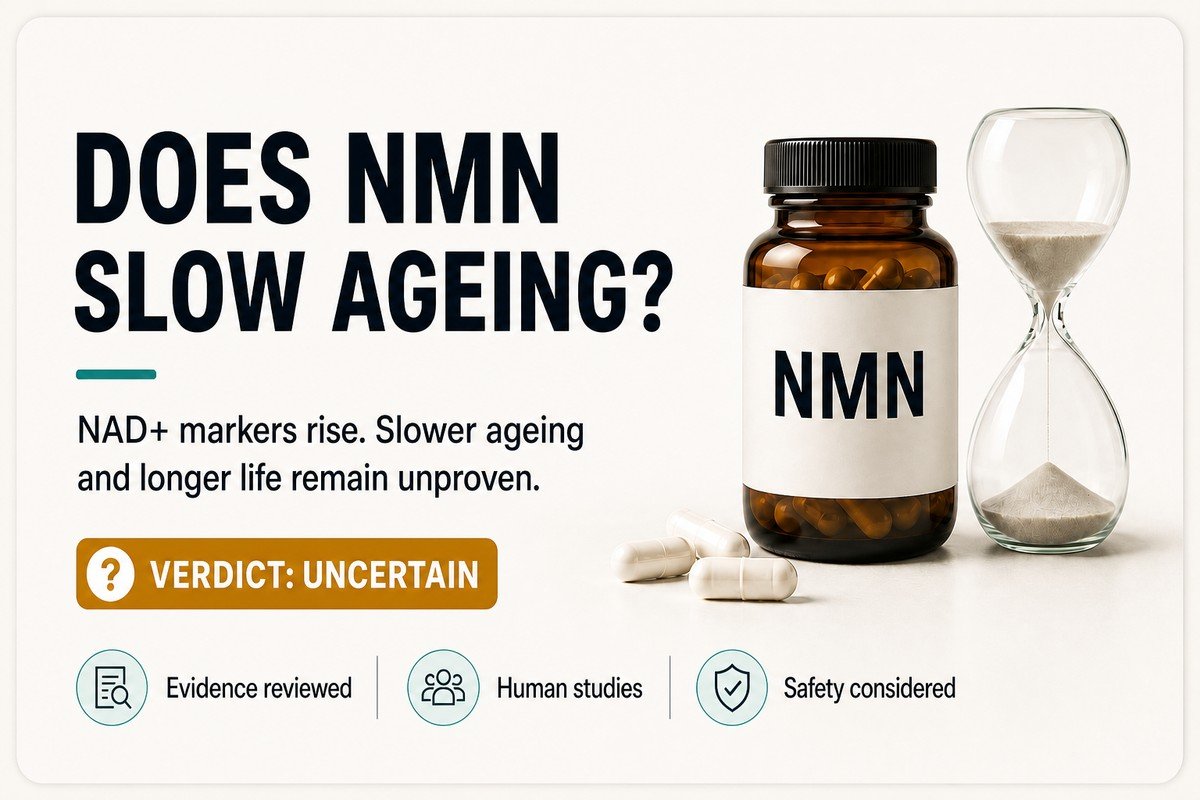
Does NMN or NAD+ supplementation slow aging and extend lifespan?
A careful look at the human evidence behind one of longevity medicine’s most popular supplement claims.
NMN can raise NAD+ related markers in humans, but no human trial has shown that NMN or NAD+ supplementation slows aging or extends lifespan.
NMN is a plausible NAD+ booster, not a proven longevity treatment. Randomized human studies show that NMN can increase NAD+ related markers, and some trials report small improvements in muscle insulin sensitivity, walking speed, sleep, or exercise-related measures. But the central claim – that NMN or NAD+ supplementation slows human aging or extends lifespan – is not supported by direct human evidence.
The claim
“NMN, NAD+, or NAD+ booster supplements slow aging, reverse biological age, and help people live longer.”
This is a broad claim, so WEH splits it into smaller claims. Does NMN raise NAD+? Does it improve aging-related body functions? Does it lower biological age? Does it extend lifespan?
The answer changes depending on which part of the claim you ask about.
Evidence at a glance
What is NMN?
NMN stands for nicotinamide mononucleotide. It is a molecule the body can use to make NAD+.
NAD+ stands for nicotinamide adenine dinucleotide. It helps cells turn food into energy and supports processes involved in DNA repair, stress responses, and metabolism. NAD+ biology is a real and important field of research, but a real mechanism does not prove a real lifespan benefit.
Human studies have mostly measured short-term biomarkers and functional tests. They have not measured whether people live longer.
What the evidence says – click any finding to expand
Each card separates a specific sub-claim from the larger marketing claim. This matters because “raises NAD+” and “extends lifespan” are not the same claim.
Supported
NMN increases NAD+ related markers in humans
GRADE: Moderate for biomarker change
v
Several randomized human studies report that oral NMN increases blood NAD+ or NAD+ metabolites. This is the most consistent human finding, and it supports the idea that NMN can act as a NAD+ precursor.
Promising
Some studies show modest metabolic or exercise-related benefits
GRADE: Low-Moderate
v
A small randomized trial in women with overweight or obesity and prediabetes found improved muscle insulin sensitivity after 10 weeks of NMN. Another randomized trial in amateur runners found improved aerobic capacity measures during exercise training, though not all exercise outcomes improved.
Promising
Some older-adult studies report small physical function or sleep improvements
GRADE: Low
v
Trials in older adults have reported findings such as maintained walking speed, improved lower limb function, reduced drowsiness, or improved sleep-quality scores. These findings are interesting because they involve outcomes people can feel, not just lab markers.
Uncertain
“Biological age” findings are not the same as proven anti-aging
GRADE: Very Low-Low
v
Some trials and product-linked studies report changes in calculated “biological age” or aging-related biomarkers. These results are hypothesis-generating, but they do not prove that a person is aging more slowly in a clinically meaningful way.
Not supported
No human evidence shows lifespan extension
GRADE: Very Low for lifespan claim
v
No randomized human trial has shown that NMN, NAD+, or related NAD+ boosters make people live longer. Human trials have generally lasted weeks or months, not years or decades.
Uncertain
Long-term safety is not well established
GRADE: Low for long-term safety
v
Short-term trials generally report good tolerability, but long-term daily use has not been studied well enough to make strong safety claims. In Australia, the TGA has set conditions for NMN-containing listed medicines, including adult-only use, oral route, a maximum recommended daily dose of 500 mg, and recommended use for 12 weeks or less.
Are the results consistent?
The evidence is consistent for NAD+ marker changes, but not for anti-aging outcomes.
Human studies generally agree that NMN can increase NAD+ related markers. They are less consistent on physical performance, metabolism, sleep, and biological-age outcomes.
This is not surprising. The studies use different doses, populations, outcome measures, and follow-up periods. Some study healthy adults. Some study older adults. Some study people with metabolic risk. A short trial in runners cannot answer the same question as a long trial of frailty, disease, or lifespan.
- Human RCTs show short-term biomarker changes and some modest functional signals.
- No human trial shows longer lifespan, lower mortality, or durable prevention of age-related disease.
- Most studies are small, short, and focused on surrogate outcomes.
- Animal data and mechanism are not enough to prove human anti-aging benefit.
Evidence summary table
For readers who want to inspect the main studies behind the verdict.
| Citation / N | Key result | Risk of bias / limits |
|---|---|---|
| Wen et al. 2024 N: Multiple RCTs |
NMN increased NAD+ related markers; clinical outcomes were limited. | Short trials, small samples, surrogate outcomes. |
| Yoshino et al. 2021 N: 25 postmenopausal women with prediabetes |
Improved muscle insulin sensitivity and insulin signaling. | Small, specific population, metabolic endpoint only. |
| Liao et al. 2021 N: 48 amateur runners |
Improved some aerobic capacity measures with exercise training. | Exercise-trained group; not an aging or lifespan study. |
| Igarashi et al. 2022 N: Older men |
Reported nominal improvements in gait speed and left grip test; no body-composition effect. | Modest effects; authors called for larger validation. |
| Kim et al. 2022 N: 108 older adults |
Afternoon NMN improved lower limb function and reduced drowsiness. | Short-term; functional and sleep-related outcomes. |
| Morifuji et al. 2024 N: Older adults |
Increased blood NAD+ levels; maintained walking speed; improved sleep-quality scores. | Short-term; not powered for disease or lifespan. |
| Yi et al. 2023 N: 80 middle-aged healthy adults |
Reported increased blood NAD+ and changes in blood biological-age measure over 60 days. | Biological age is a surrogate; short follow-up. |
| TGA 2025 N: Not applicable |
Set adult-only, oral-route, dose and duration conditions for NMN listed medicines in Australia. | Regulatory conditions are not proof of anti-aging efficacy. |
What this means for you
Practical takeaway
If your goal is to raise NAD+ related markers, NMN appears capable of doing that.
If your goal is to slow aging, reverse biological age, or live longer, the evidence is not there yet.
- Treat NMN as experimental for longevity, not proven.
- Be skeptical of lifespan, “reverse aging,” or “cellular age reset” claims.
- Do not confuse animal data, mechanisms, or biomarker changes with demonstrated human lifespan benefit.
- Prioritize exercise, sleep, blood pressure control, smoking avoidance, healthy diet, and social connection, which have stronger real-world evidence for healthy aging.
Sources
- Wen J, et al. Efficacy and safety of nicotinamide mononucleotide supplementation: a systematic review of randomized controlled trials. 2024. Study type: systematic review of RCTs. Full text
- Igarashi M, et al. Chronic nicotinamide mononucleotide supplementation elevates blood nicotinamide adenine dinucleotide levels and alters muscle function in healthy older men. NPJ Aging. 2022. Study type: randomized controlled trial. PMID: 35927255. PubMed
- Yi L, et al. The efficacy and safety of beta-nicotinamide mononucleotide supplementation in healthy middle-aged adults. GeroScience. 2023. Study type: randomized controlled trial. DOI: 10.1007/s11357-022-00705-1. Journal page
- Yoshino M, et al. Nicotinamide mononucleotide increases muscle insulin sensitivity in prediabetic women. Science. 2021;372(6547):1224-1229. Study type: randomized controlled trial. PMID: 33888596. PubMed
- Liao B, et al. Nicotinamide mononucleotide supplementation enhances aerobic capacity in amateur runners: a randomized, double-blind study. J Int Soc Sports Nutr. 2021;18:54. Study type: randomized controlled trial. PMID: 34238308. PubMed
- Kim M, et al. Effect of 12-week intake of nicotinamide mononucleotide on sleep quality, fatigue, and physical performance in older adults. Nutrients. 2022. Study type: randomized controlled trial. PMID: 35215405. PubMed
- Morifuji M, et al. Ingestion of beta-nicotinamide mononucleotide increased blood NAD+ levels and improved sleep quality in older adults. 2024. Study type: randomized controlled trial. PMID: 38789831. PubMed
- Freeberg KA, et al. Dietary supplementation with NAD+-boosting compounds in humans. 2023. Study type: narrative review. Full text
- Therapeutic Goods Administration. NAD, NAD+, NADH or NMN medicines sold in Australia. Published 7 April 2025. Study type: regulatory safety alert. TGA